
‘No food in Ceuta, kicked out badly’: Why thousands of migrants headed back to Morocco after entering Spain

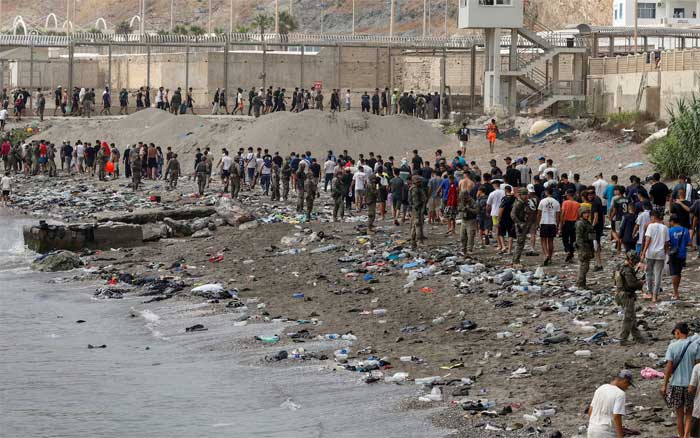
Thousands of migrants who entered Spain’s North African enclave of Ceuta have begun returning voluntarily to Morocco, just a day after a chaotic mass crossing that left at least 57 people dead and overwhelmed local authorities.
Spanish officials said that most of the more than 50,000 migrants who entered the territory by land and sea were making their way back on their own after finding little access to food, shelter or other basic necessities.
Why are migrants returning?
Moroccan security forces have tightened controls along the border, using batons and tear gas to prevent more people from entering Ceuta. On the Spanish side, military vehicles and security personnel remain deployed as authorities work to restore order.
Hundreds of migrants have been seen crossing back into Morocco through official checkpoints and gaps in the border fence.
Many said they decided to leave after struggling to survive inside the enclave.
A young migrant from Tangier told Reuters he had not eaten since the previous afternoon and regretted making the journey.
Another migrant, 20-year-old Ayman from Larache, said he swam for nearly five hours to reach Ceuta but found no food and claimed migrants were forcibly removed by Spanish security forces.
A humanitarian crisis
Authorities estimate that around 45,000 of the roughly 60,000 people who crossed into Ceuta between Thursday and Friday had already returned to Morocco within hours.
The sudden influx—equivalent to nearly 70% of Ceuta’s population—left thousands sleeping on streets and public spaces, prompting Spain to deploy additional police and military personnel.
The tragedy claimed at least 57 lives, with victims reportedly dying from drowning and crowd crushes during the crossing.
What triggered the surge?
Ceuta officials have linked the unprecedented influx to a recent Spanish Supreme Court ruling that limits the immediate return of migrants intercepted at sea under the enclave’s long-standing “border rejection” policy. The ruling does not apply to migrants who enter by land.
Spanish Prime Minister Pedro Sánchez described the mass crossing as “a violation of Spain’s territorial integrity” and blamed human smuggling networks for encouraging dangerous journeys that have cost dozens of lives.
Some analysts have also pointed to Spain’s recent immigration reforms, including measures to regularise undocumented migrants already living in the country, as one factor that may have influenced migration flows, although the exact reasons behind the surge remain under debate.
Comments are closed.