
7,000 feet up, alone and armed only with a handgun: Inside a US airman’s 48-hour survival in Iran

Every US service member undergoes rigorous training for the worst-case scenario: being shot down, isolated, and hunted in hostile territory. Last week, one airman found himself living that reality.
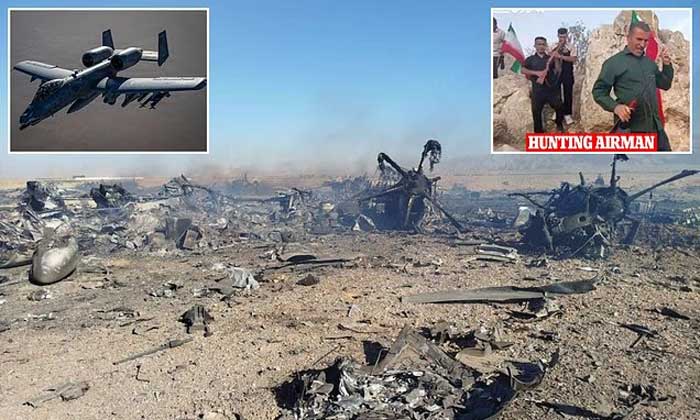
On April 3, an F-15E Strike Eagle was downed over southwestern Iran. While the pilot was rescued quickly, the search for the aircraft’s weapons systems officer — a colonel — stretched into a tense, two-day operation. Tehran even announced a $60,000 reward for information leading to his capture, urging civilians to join the hunt.
The missing officer was finally rescued on Sunday in what Donald Trump described as “the most daring” search-and-rescue mission in US history. His survival for nearly 48 hours behind enemy lines, constantly evading capture, has drawn comparisons to a Hollywood thriller.
Survival in hostile terrain
As both Iranian and US forces raced to locate him, the airman relied on stealth and endurance. He reportedly hid in a mountain crevice, kept moving to avoid detection, and at one point climbed a 7,000-foot ridgeline to stay ahead of pursuing forces. Armed with a handgun, a communication device, and a tracking beacon, he remained off the grid — even to US forces — for more than 24 hours.
“This brave warrior was behind enemy lines in the treacherous mountains of Iran, being hunted down by our enemies,” Trump said.
According to reports from CBS News and The New York Times, the Central Intelligence Agency eventually pinpointed his location using advanced tracking capabilities as he navigated rugged terrain and avoided detection.
Once confirmed, the intelligence was shared with the White House and the Pentagon, and a special forces team was deployed near his position on Saturday night. Despite injuries, the officer was successfully extracted, with no casualties reported among the rescue team.
Trump called it unprecedented, claiming it marked the first time two US crew members from the same incident were rescued separately deep inside enemy territory.
The role of SERE training
US officials credited the airman’s survival to SERE training — a mandatory program that prepares personnel to survive, evade capture, resist interrogation, and escape if isolated.
The training emphasizes adaptability, mental resilience, and decision-making under extreme stress. Pilots are equipped with survival kits stored beneath their ejection seats, along with vests carrying essential gear such as radios, helmets, and weapons.
Retired brigadier general Houston Cantwell described the shock of ejection, noting how quickly pilots must transition from high-speed combat to survival mode on the ground.
Experts say that in such scenarios, a combination of training, instinct, and rapid military coordination significantly boosts survival chances.
Conflicting claims
Iran, however, has rejected the US version of events. Ebrahim Zolfaghari, spokesman for the Khatam Al-Anbiya central command, claimed the rescue attempt was “completely foiled.”
In a statement broadcast on state television, he alleged that US aircraft involved in the operation — including transport planes and helicopters — were destroyed, and dismissed Trump’s account as “empty rhetoric.”
The sharply conflicting narratives underscore the fog of war surrounding the high-stakes operation, even as the rescued airman’s survival story continues to unfold.
Comments are closed.