
North Korea tests cluster-armed ballistic missiles, ramps up bid to outpace US–South Korea defenses

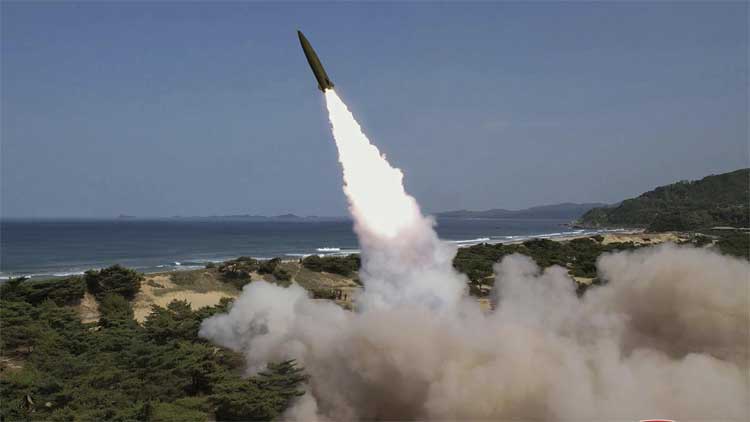
North Korea on Monday said it had test-launched ballistic missiles fitted with cluster bomb warheads—its second such test this month—highlighting efforts to strengthen its ability to penetrate US and South Korean missile defenses.
According to the state-run Korean Central News Agency (KCNA), the test appeared to correspond to multiple launches detected Sunday by South Korea, Japan and the United States off the country’s east coast.
Images released by KCNA showed leader Kim Jong Un and his teenage daughter, widely believed to be Kim Ju Ae, observing the launch from a coastal site as a missile streaked over the sea trailing smoke. South Korea’s intelligence agency has suggested she may be a potential successor.
KCNA said Kim oversaw the firing of five upgraded Hwasong-11 Ra surface-to-surface ballistic missiles equipped with cluster bomb and fragmentation mine warheads. The missiles reportedly hit an island target, with Kim emphasizing the importance of enhancing “high-density striking capability.”
Earlier this month, North Korea tested the Hwasong-11 Ka, also fitted with cluster warheads, which it claimed could devastate targets spread over several hectares.
While North Korea has previously tested cluster munitions, analysts say recent conflicts—particularly tensions involving Iran—may have accelerated its efforts to refine such weapons and demonstrate their effectiveness. Cluster munitions disperse multiple smaller explosives mid-air, making them difficult to intercept and capable of covering wide areas.
More than 120 countries have signed a global treaty banning cluster munitions, though North Korea, Iran, Israel and the United States are not signatories.
The tests come as Pyongyang continues to expand its military capabilities following the collapse of nuclear diplomacy between Kim and former US President Donald Trump in 2019. North Korea has since pursued advanced systems including multi-warhead missiles, hypersonic weapons and submarine-launched ballistic missiles—developments that could complicate US and South Korean defense strategies.
Trump has signaled interest in reviving talks with Kim, while Pyongyang has indicated openness to dialogue but insists Washington must drop demands for denuclearization as a precondition.
Trump is expected to travel to Beijing in May for a rescheduled summit with Xi Jinping. Analysts believe North Korea’s recent missile activity may be aimed at strengthening its bargaining position ahead of potential diplomatic openings tied to that meeting.
Comments are closed.