
Guterres calls for urgent climate action, says fossil fuel dependence is fuelling global crises

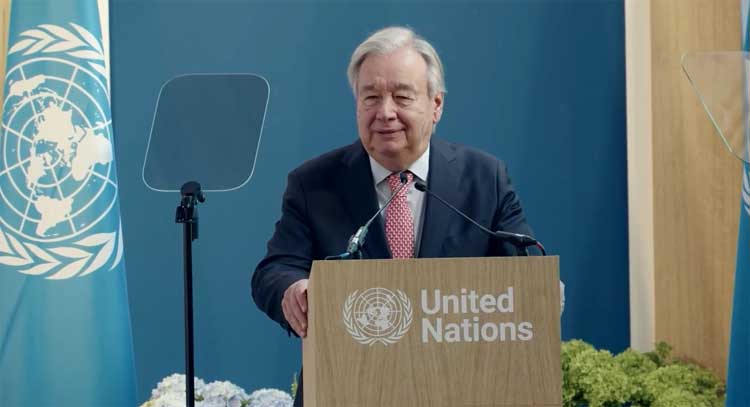
As a severe heatwave swept across Europe, UN Secretary-General António Guterres issued a strong warning over the growing climate crisis and called for urgent global action to reduce dependence on fossil fuels.
Speaking at London Climate Action Week, Guterres urged governments to accelerate the shift to clean energy and called on artificial intelligence companies to reveal the full environmental impact of their data centres, including carbon emissions, water use and land footprint.
The UN chief said the climate crisis, energy insecurity and geopolitical tensions are linked by a common factor — the world’s continued reliance on fossil fuels.
“These crises may seem separate but they share the same destructive origin: fossil fuels,” Guterres said, calling for a rapid and fair transition to renewable energy along with greater investment in climate adaptation and justice.
He compared the scale of action needed today to previous global efforts such as ending the use of leaded gasoline and banning chemicals responsible for ozone depletion.
UN’s seven-point plan for energy independence
Guterres outlined a roadmap focused on reducing emissions, expanding clean energy and protecting vulnerable communities.
Key priorities include:
- Cutting emissions rapidly: Global emissions must peak immediately and reach net zero by 2050, with stronger efforts to reduce methane pollution.
- Speeding up renewable energy: Governments should expand clean energy investment, end subsidies for new fossil fuel projects and redirect funding toward vulnerable communities.
- Making AI cleaner: Major technology companies should disclose the environmental impact of data centres and ensure they run on renewable energy by 2030.
- Ensuring a fair transition: The move away from fossil fuels should create jobs and support developing economies.
- Building climate resilience: Countries must invest more in adaptation measures, early warning systems and disaster preparedness.
- Improving climate finance: Developing nations need greater access to affordable funding for clean energy and climate protection.
- Protecting science and truth: Governments should fight climate misinformation and support environmental researchers and journalists.
Warning over climate tipping points
More than a decade after the Paris climate agreement set the goal of limiting global warming to 1.5°C above pre-industrial levels, UN scientists warn that the threshold could be exceeded in the coming years.
Guterres stressed that every fraction of a degree matters, warning that rising temperatures could cause irreversible damage to coral reefs, accelerate ice-sheet melting and threaten vulnerable coastal communities.
“The task before us is to strictly limit the overshoot, shorten its duration and bring temperatures down below 1.5°C as fast as possible,” he said.
Fossil fuels and global instability
Addressing the energy impact of conflicts in West Asia, Guterres said the disruption caused by the Middle East crisis represented one of the biggest energy shocks since the 1970s oil crisis and Russia’s invasion of Ukraine.
He said developing countries were suffering the most, facing a combination of debt, food and development crises.
However, he highlighted the falling cost of renewable technologies, saying solar power costs have dropped sharply since 2010, while wind energy and battery storage have also become significantly cheaper.
“There are no embargoes on sunlight and no blockades on the wind,” Guterres said, arguing that renewable energy offers a path toward greater energy security.
AI’s growing environmental footprint
The UN chief also raised concerns about the environmental impact of artificial intelligence.
He said AI data centres already consume large amounts of electricity and warned that their future water demand could become enormous without stronger sustainability measures.
Guterres called on major AI companies to “come clean” by publicly reporting the environmental cost of their operations.
Protecting nature and communities
Later, while receiving the Kew International Medal, Guterres highlighted the impact of climate change on ecosystems, citing damage to trees and biodiversity at the Royal Botanic Gardens during recent droughts.
He said protecting forests, restoring ecosystems, safeguarding oceans and shifting away from fossil fuels must happen together.
“When the climate crisis comes for the great trees of Kew, it is a warning to us all,” Guterres said, urging greater investment in nature-based solutions for a safer future.
Comments are closed.