
ASEAN forum urges stronger measures to tackle climate change

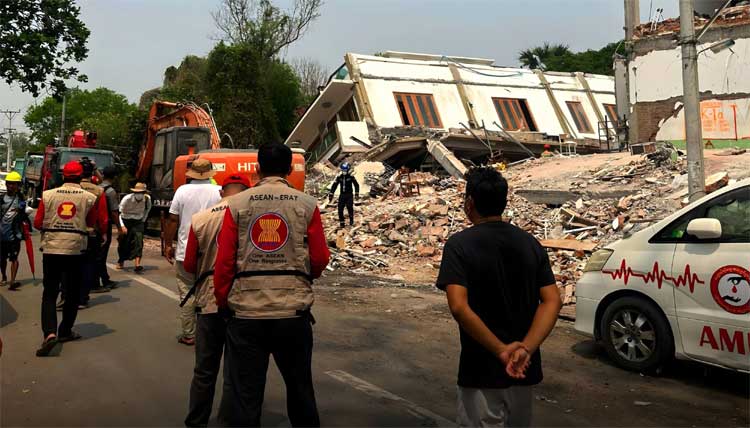
Climate resilience is no longer just an environmental concern but an economic imperative for Southeast Asia, experts said at a regional forum in Bangkok, warning that extreme weather, fragmented governance and outdated infrastructure are threatening the region’s economic competitiveness.
The issue was discussed at an ASEAN Forum 2026 panel on “Strengthening ASEAN’s Physical Resilience” in August, where experts argued that climate risks must be treated as a development and economic priority rather than left primarily to environment ministries.
Witaya Wannasuphoprasit, dean of engineering at Chulalongkorn University, said Thailand’s vulnerability reflects three interconnected problems.
He pointed to increasingly erratic rainfall that can overwhelm drainage systems designed for older climate patterns, decades of unplanned urban expansion that have reduced natural floodplains, and fragmented water management involving around 50 government agencies with separate budgets, priorities and limited data sharing.
Witaya said water should not be viewed only as a threat but also as a productive resource. Citing UN data covering roughly two decades, he noted that water productivity — the economic value generated per cubic metre of water used — has stagnated across Southeast Asia even as other regions have improved.
He also called for greater involvement of local communities, including through “water schools” designed to help residents understand and manage flood and drought risks.
Wannaporn Phornprapha, founder and managing director of landscape architecture firm P Landscape Company, said the region remains overly dependent on “gray” infrastructure such as concrete systems instead of incorporating natural solutions.
She identified fragmented planning as one of the biggest weaknesses, noting that projects are often designed to withstand specific flood risks without considering what happens beyond their boundaries. “Water has no boundary,” she said.
Wannaporn also highlighted gaps in regulation and data, as well as the perception that climate-resilient design is an unnecessary additional cost. She argued that its benefits, including better public health, livability and long-term economic value, are often difficult to quantify.
Satoshi Iemoto, an expert associated with a Japan International Cooperation Agency project, said countries cannot tackle climate adaptation independently because rivers, coastlines and other natural systems cross national borders.
He recommended greater knowledge-sharing among countries facing similar disaster risks, stronger participation by local governments and communities, and a combination of modern technology with traditional knowledge and community-based practices.
The panelists said Southeast Asia’s resilience problem is driven less by a lack of technical expertise than by fragmentation across government agencies, data systems, construction projects and national policies.
They called for greater integration of existing resources, including shared data, nature-based infrastructure, local knowledge and cross-border cooperation, arguing that climate resilience must become a collective responsibility across countries and sectors.
Comments are closed.