
Nepal Flash Flood: Seismic Activity, Climate Change May Have Triggered Catastrophe, Says UN Expert

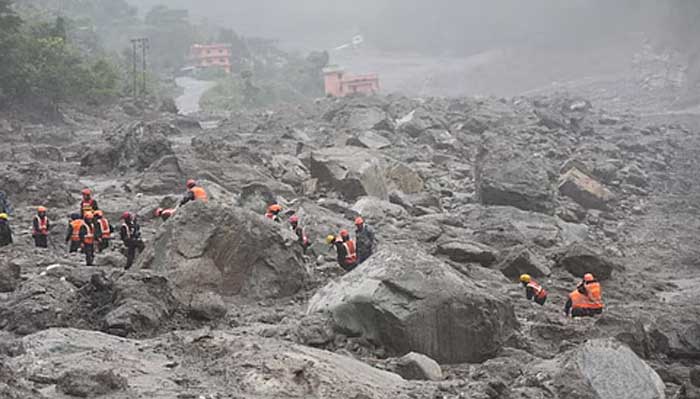
Seismic activity may have played a role in triggering the devastating flash flood and avalanche that struck Nepal’s Rasuwa district on August 26, while climate change could have contributed to the underlying conditions, according to a UN glacier expert.
At least 734 people have reportedly died in the disaster, with thousands more missing or injured. Dipesh Chapagain, a senior scientist with the Global Mountain Safeguard Research (GLOMOS) programme at the United Nations University Institute for Environment and Human Security (UNU-EHS), said the relationship between seismic activity and the suspected ice-rock avalanche remains unclear.
“Seismic activity might have triggered the avalanche, but according to United States Geological Survey reports it may be the other way around, with the avalanche triggering seismic activity,” Chapagain said in an interview on August 27. “We cannot rule out both working in tandem; the findings are evolving.”
According to the expert, a large section of an evolving glacier on the Nepal side of the Himalayas may have collapsed, leading to ice melt, temporary river blockage and a subsequent avalanche and flash flood.
Seismic signals detected near disaster site
The possibility of seismic activity has also been highlighted by the International Centre for Integrated Mountain Development (ICIMOD).
A preliminary analysis of seismic records found unusual signals around the time of the disaster. Data from a seismometer in Jilong, around 12 kilometres from the affected area, showed anomalous activity, while another station in Zhangmu also recorded unusual signals.
Scientists are now examining whether the signals were connected to the suspected ice-rock avalanche.
The disaster occurred after a large volume of ice and rock debris is believed to have entered the Lhende Khola, a tributary of the Bhote Koshi river. The sudden movement may have generated a powerful surge carrying water, sediment and large boulders downstream.
Experts warn of another possible flood
Experts have also warned of the possibility of another disaster in the region.
Chapagain said another glacial lake appeared to be forming near the Nepal-China border, raising concerns that a potential breach could trigger another avalanche and flood.
Qianggong Zhang, head of climate and environmental risks at ICIMOD, said the same area devastated by last year’s Rasuwa flood was once again under threat.
“An ice avalanche in the Lhende Khola is the suspected trigger, but the cause remains unconfirmed,” Zhang said, adding that a blockage remained upstream on the Nepal-China border.
China reportedly issued a high-risk 72-hour alert over a newly formed transboundary glacial lake, with peak water flow initially expected around September 1. However, the immediate threat of a catastrophic breach has subsequently eased as the lake began naturally overflowing and draining.
Climate change linked to rising GLOF risk
Chapagain said rising temperatures and climate change have contributed to the growing frequency of Glacial Lake Outburst Floods (GLOFs) across the Hindu Kush Himalayas.
An ongoing study involving nearly 500 GLOF events found that the frequency of such incidents has increased fivefold since 1950.
The Hindu Kush Himalaya region stretches across Afghanistan, Pakistan, India, China, Nepal, Bhutan, Bangladesh and Myanmar and contains thousands of glaciers and glacial lakes.
The study found that ice avalanches accounted for around half of recorded GLOF triggers, while intense rainfall contributed to another 25%. Around 70% of the events occurred during the summer monsoon, when temperatures and precipitation are simultaneously high.
Researchers say the findings point to a strong connection between climatic conditions and the rising risk of GLOFs.
Warming makes natural dams increasingly unstable
The study also identifies moraine- and ice-dammed lakes as particularly vulnerable. Together, they account for around 80% of observed GLOF events and almost all recorded fatalities in the region.
As temperatures rise, increased glacier melt and sediment inflow can raise water levels and place greater hydrostatic pressure on natural dams. These unstable barriers can then be breached by additional triggers, including ice or snow avalanches, landslides and seismic activity.
The Hindu Kush Himalayas had more than 64,000 glaciers across 12 major river basins as of 2020, along with more than 23,000 glacial lakes. About 407 of these lakes have been classified as potentially dangerous.
The highest GLOF risks are concentrated in the eastern Himalayas, particularly along the China-Nepal border.
India faces serious GLOF vulnerability
A UN-led study covering GLOF events between 1835 and 2025 has identified India as the country with the highest number of fatalities from such disasters in the Hindu Kush Himalaya region.
The study recorded 62 GLOF events in India and 58 in Nepal, compared with 199 in China and around 152 in Pakistan. Despite experiencing fewer events than China and Pakistan, India recorded 6,119 deaths, compared with 625 in China and 1,991 in Pakistan.
India has also experienced the most severe GLOF-related displacement in the region, followed by Nepal and Pakistan, according to the study.
The report notes that India, Nepal and Pakistan face heightened GLOF risks because of their exposure to earthquakes, which can increase the likelihood of glacial lake outbursts and flash floods. Changes in glacier mass balance are also considered an important indicator of climate change across the region.
India’s preparedness under scrutiny
The study has raised concerns about the adequacy of India’s measures to tackle GLOF risks. India’s adaptation efforts have been classified as “moderate”, with only seven measures listed among 62 assessed initiatives.
Its access to international financing for glacier adaptation has also been categorised as “low”.
Climate experts have warned that India needs to strengthen its glacier monitoring, early-warning systems and disaster preparedness rather than relying primarily on international assistance.
They pointed to previous disasters, including the Chamoli disaster and the 2023 Teesta River flash flood in Sikkim and West Bengal, as warnings that the region’s vulnerability is increasing.
With millions of people living downstream of vulnerable Himalayan glaciers and river systems, experts say Nepal’s latest catastrophe should serve as a warning for India and other countries in the Hindu Kush Himalayas to urgently strengthen their preparedness for cascading glacier-related disasters.
Comments are closed.