
Supreme Court Bars Illegal Detention Of Peaceful Protesters, Directs Free Movement In Delhi

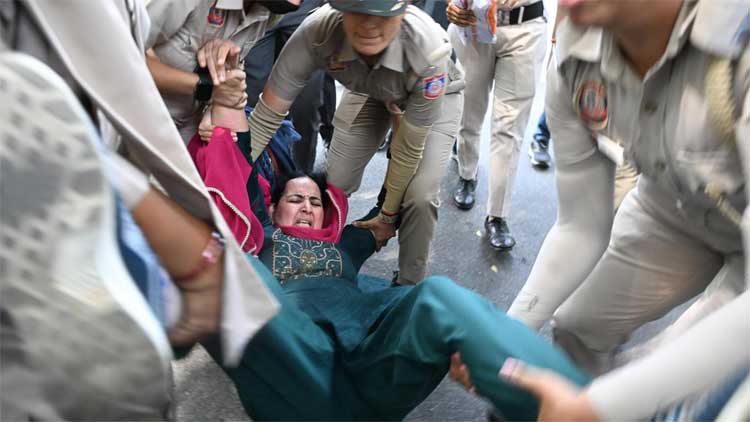
The Supreme Court on Sunday directed authorities to ensure the normal operation of metro and railway services in Delhi, restore free movement across the city and maintain uninterrupted internet connectivity, while emphasising that peaceful, unarmed protesters cannot be detained except in accordance with the procedure established by law.
A special bench of Justices Joymalya Bagchi and V Mohana also ordered authorities to remove notices imposing prohibitory restrictions around the Supreme Court and other court complexes, stressing the need to ensure unhindered access to justice.
The directions came during an urgent hearing on petitions alleging mass detentions, restrictions on movement, internet disruptions and non-compliance with the court’s October 9 order concerning public transport restrictions ahead of Saturday’s protest against Chief Election Commissioner (CEC) Gyanesh Kumar.
The bench clarified that metro and railway services should operate normally unless restrictions are necessary to address a public order situation within the framework of Article 19(2) of the Constitution. It also directed authorities to ensure that people could move freely, subject to law, and that internet services remained undisturbed in accordance with legal requirements.
The court specifically said that peaceful, unarmed assemblies outside areas covered by prohibitory orders under Section 163 of the Bharatiya Nagarik Suraksha Sanhita (BNSS) should not result in detentions except in accordance with the procedure established by law.
Supreme Court Seeks Responses From Delhi Police, DMRC
The bench issued notices to the alleged contemnors, including the Delhi Metro Rail Corporation (DMRC), the concerned railway authorities and Delhi Police, seeking their responses to allegations that the court’s October 9 directions had not been implemented.
It directed the authorities to submit short affidavits addressing the contempt pleas and compliance reports detailing the steps taken to implement the earlier order on regulated metro and railway services and the publication of traffic advisories.
Solicitor General Tushar Mehta, appearing for the Centre and Delhi Police, disputed the allegations, maintaining that metro services had operated normally on Saturday, although entry and exit were restricted at 45 of the network’s 303 stations.
The bench sought details of the affected stations, including their locations, to assess the extent of the restrictions and their impact on public access. It directed the authorities to file their responses by Tuesday and listed the matter for October 13.
The court also ordered the removal of notices imposing Section 163 BNSS restrictions in and around the Supreme Court complex, saying the measure was necessary to eliminate any apprehension about access to the Supreme Court or other courts.
Court Questions Restrictions On Peaceful Protests
Sunday’s directions followed the court’s intervention on Friday against sweeping restrictions on public transport ahead of a protest called by the Cockroach Janata Party (CJP) and other political groups demanding Kumar’s resignation over alleged irregularities in the Special Intensive Revision (SIR) of electoral rolls.
On October 9, a bench led by Chief Justice of India Surya Kant had directed authorities to reconsider the proposed closure of metro stations and regulate, rather than prohibit outright, metro and railway services to minimise inconvenience to commuters.
At Sunday’s hearing, petitioners alleged that the earlier order had been flouted, claiming that metro stations and railway facilities remained inaccessible, people were detained beyond areas covered by prohibitory orders, and Delhi witnessed a curfew-like situation.
The bench examined whether the police action was consistent with constitutional protections for freedom of expression, peaceful assembly and movement.
“We would like to ponder on how far the police acts fall in sync with requirement of expression under Article 19 (right to protest and free movement),” the bench observed.
It also emphasised that the court’s responsibility was to protect the rights and liberties of everyone, regardless of their identity or position.
“Courts are agnostic of identity of the individuals, be it a police officer or a lawyer. Response and concerns of the court is to protect rights and liberty of all individuals,” the bench said.
Lawyers Allege Police Excesses, Illegal Detentions
The petitions followed a police crackdown during Saturday’s protests, when Opposition leaders, students, lawyers and other demonstrators were detained amid heightened security across Delhi.
Trinamool Congress MP and senior advocate Menaka Guruswamy challenged the preventive detention of Opposition leaders, including four former chief ministers. Other petitions questioned the legality of the restrictions and sought accountability for alleged police excesses.
Senior advocates KK Venugopal, Kapil Sibal, Gopal Sankaranarayanan and others appeared before the bench. The Supreme Court Advocates-on-Record Association (SCAoRA) and other lawyers also raised concerns about restrictions on movement and the detention of advocates.
Senior advocate Shadan Farasat, appearing for SCAoRA, described the situation in Delhi as suppressive and alleged that people were not being allowed to stand or move around freely. He told the court that he had himself been picked up and thrown into a moving bus, adding that the city was “one step away from a police state”.
Sankaranarayanan submitted that videos and photographs placed on record showed senior advocates, including Dinesh Dwivedi, Uttara Babbar and Farasat, being detained beyond the jurisdiction of Jantar Mantar.
He also alleged that Section 163 BNSS had been imposed around the Supreme Court and claimed that children, women, students and elderly people had been pushed, shoved or assaulted.
Senior advocate Sanjay Hegde argued that access to lawyers was an essential component of access to justice. He alleged that advocates had been detained and taken to police stations far from the protest site, with some reportedly beaten.
The bench acknowledged the concerns raised by the lawyers and said it understood the scale of the alleged detentions.
Justice Mohana urged those seeking to exercise their right to protest to remain peaceful and avoid provocation.
“Please, undertake you will protest peacefully and not instigate,” she told counsel.
Justice Bagchi, meanwhile, assured Mehta that the court would remain neutral while examining the allegations.
“Please be assured that we will remain neutral arbiters. But at the same time, we are duty bound under Article 32 to protect and safeguard fundamental rights of the citizens,” he said.
Right To Protest Subject To Legal Restrictions
The hearing also examined the constitutional limits on the right to protest. Senior advocate Shoeb Alam argued that the restrictions violated rights guaranteed under Article 19(1) of the Constitution.
The bench noted that these rights were subject to reasonable restrictions under Article 19(2), but stressed that restrictions should not automatically translate into a complete prohibition.
“The process in which you protest has to be in accordance with the law. Right to protest cannot be beyond the legal framework or in violation of Article 19(2),” the bench observed.
Guruswamy argued that the issue extended beyond the individuals named in the petitions. She submitted that young people had taken to peaceful protests because they believed the electoral system was not fair and just, and alleged that the detention of thousands of people had effectively curtailed citizens’ right to protest.
Referring to the Emergency and the Supreme Court’s controversial 1976 ruling in the ADM Jabalpur case, she urged the court not to repeat the mistakes of that period. She also sought contempt action against officials allegedly responsible for disobeying the court’s earlier directions.
Contempt Plea Names Home Secretary, Delhi Police Commissioner
The contempt petition, filed by advocate Shailendra Mani Tripathi, names Union Home Secretary Govind Mohan, Delhi Police Commissioner Anurag Kumar and DMRC chairperson D Thara.
It alleges that authorities failed to comply with Friday’s order concerning the reconsideration of proposed restrictions at 57 metro stations, regulated railway services and the wide publication of traffic advisories.
Mehta disputed the allegations, telling the bench that metro services had not been curtailed in the manner claimed by the petitioners.
He said entry and exit had been restricted at 45 of the Delhi-NCR network’s 303 stations, while more than 4,000 train trips had operated on Saturday. He also submitted that all metro stations had been open since 10 pm on Saturday, services were running normally and internet connectivity had been restored.
The bench sought detailed information about the 45 affected stations and asked authorities to provide details of railway advisories and respond to the petitions and contempt allegations by Tuesday.
On Friday, the CJI-led bench had questioned the apparent contradiction in the metro advisory, which referred both to reducing train frequency and closing station gates.
“Stopping something and regulating are two different concepts,” the bench had observed, directing authorities to reconsider the restrictions and ensure that public transport continued operating in a suitable and regulated manner.
The court had also ordered fresh traffic advisories to be published in newspapers and on online platforms, directing the DMRC, railway authorities and Delhi Police’s traffic wing to submit compliance reports within four days.
At Sunday’s hearing, the bench said authorities would have to explain three aspects of the protesters’ detention: the circumstances in which they were detained, the manner in which the detentions were carried out, and the justification for the action.
The matter will next be heard on October 13, when the court is expected to consider the authorities’ responses and compliance reports.
Comments are closed.