
Zelensky, Hungary’s Peter Magyar Meet in Ukraine, Pledge to Open a New Chapter in Bilateral Ties

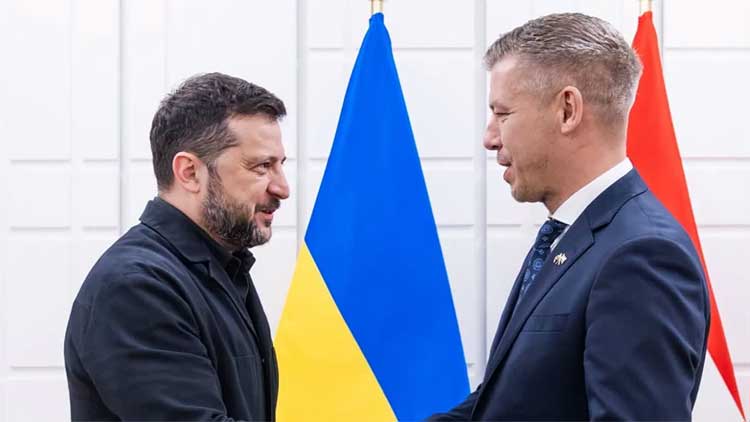
Ukrainian President Volodymyr Zelensky and Hungarian Prime Minister Peter Magyar held talks in western Ukraine on Tuesday, signalling a fresh start in relations between the two neighbouring countries after years of diplomatic tensions under former Hungarian leader Viktor Orban.
Magyar, a pro-European Union conservative who took office in May, travelled to Ukraine’s westernmost region of Transcarpathia to meet Zelensky. The region is home to a significant ethnic Hungarian minority and has long been at the centre of disagreements between Kyiv and Budapest.
The Hungarian prime minister met Zelensky in Uzhgorod, where the two leaders laid wreaths at a local cemetery and held bilateral discussions. They later travelled to the border town of Berehove for a joint media briefing.
Calling the meeting an important development, Zelensky described the discussions as positive and acknowledged the sensitivity surrounding the relationship between the two countries.
“This is an important moment and it is very sensitive,” the Ukrainian president said.
Magyar also welcomed the diplomatic breakthrough, emphasising the importance of restoring trust between neighbouring nations.
“It is in the interests of all neighbours to maintain good relations with one another. I am very grateful that you have been able to achieve this; let us begin to build trust — better late than never,” he said.
In a symbolic gesture highlighting the improved atmosphere, the two leaders also played a volleyball match at a school in Transcarpathia.
End of Orban Era Opens Door for Improved Relations
Relations between Ukraine and Hungary deteriorated significantly during Viktor Orban’s tenure. The former Hungarian prime minister maintained close ties with Moscow despite Russia’s full-scale invasion of Ukraine, while repeatedly clashing with Kyiv over minority rights and European Union policies.
Tensions had effectively frozen diplomatic relations between the neighbouring countries, with Budapest frequently opposing or delaying European initiatives supporting Ukraine.
However, relations have improved following Kyiv’s recent adoption of legislation addressing Hungary’s longstanding concerns about the rights of Ukraine’s ethnic Hungarian minority.
Following the legislative move, Hungary agreed to allow the European Union to open new chapters of membership negotiations with Ukraine.
During his visit, Magyar also met members of the local Hungarian community, who he said welcomed the improvement in relations.
“They’re very pleased that the two countries have finally started to move closer to one another, that we’ve finally put a stop to this completely unnecessary and inexplicable political escalation,” Magyar said.
He added that the discussions included symbolic cooperation projects, including the reconstruction of a Hungarian high school in Berehove, which will mark its 125th anniversary next year.
Zelensky Seeks Hungary’s Support for Ukraine’s EU Membership
Ukraine’s European Union membership ambitions were among the key issues discussed during the meeting. Zelensky said Kyiv was counting on support from Hungary under its new leadership as Ukraine continued its efforts to join the bloc.
The Ukrainian president also appeared to take a swipe at Orban’s close relationship with Russian President Vladimir Putin.
“In order to end the war, solidarity with Ukraine is essential, whilst friendship with Putin leads to nowhere,” Zelensky said.
He described his discussion with Magyar about Ukraine’s EU ambitions as “absolutely honest”.
Zelensky acknowledged that the Hungarian prime minister remained sceptical about Ukraine joining the European Union in the near future. However, he insisted that Kyiv’s European integration remained a permanent strategic objective.
“I said quite frankly today, Prime Minister, that for us this is an irreversible path,” Zelensky said.
He added that Ukraine would not return to Russia’s sphere of influence, describing European integration as the choice of the Ukrainian people.
Ukraine’s pro-European ambitions gained momentum during the 2014 revolution, which led to the overthrow of a Moscow-backed government.
Magyar, meanwhile, reiterated that the Hungarian people strongly opposed Russia’s invasion of Ukraine, marking another departure from Orban’s approach to the conflict.
“I would like you to know that the Hungarian people deeply condemn this appalling Russian aggression,” he said.
Energy Cooperation and Humanitarian Assistance on Agenda
Energy security and transport cooperation also featured prominently in the discussions as Ukraine prepares for another winter amid continued Russian attacks on its infrastructure.
Zelensky said the two leaders discussed the possibility of supplying Hungarian diesel to Ukraine, as well as cooperation that could help Kyiv maintain exports during wartime.
Highlighting the challenges facing the country, the Ukrainian president said communities were dealing with electricity shortages while continuing to defend themselves against Russian attacks.
“There is a shortage of electricity and so on, and our people are defending themselves, our communities are defending themselves. We are counting on Hungary’s support as well,” Zelensky said.
Magyar announced that Hungary would provide humanitarian assistance worth approximately $2.9 million. The aid package includes medicines and energy-related equipment to support Ukrainian communities.
Russia’s full-scale invasion, now entering another winter, has resulted in hundreds of thousands of casualties and displaced millions of people.
A New Beginning for Ukraine-Hungary Ties
The meeting in Transcarpathia represents a significant diplomatic shift after years of strained relations between Kyiv and Budapest.
Although differences remain over Ukraine’s European Union membership timeline and other policy issues, both leaders have expressed a willingness to rebuild confidence and expand cooperation.
With Magyar replacing Orban, Kyiv is hoping for a more constructive relationship with its EU and NATO neighbour, particularly on European integration, energy security and humanitarian assistance.
The latest talks suggest that both countries are interested in moving beyond years of political confrontation and establishing a more cooperative partnership.
Comments are closed.