
Constitution Day 2026: PM Modi Targets Previous Governments Over Emergency, Article 370; Assures Women on Reservation

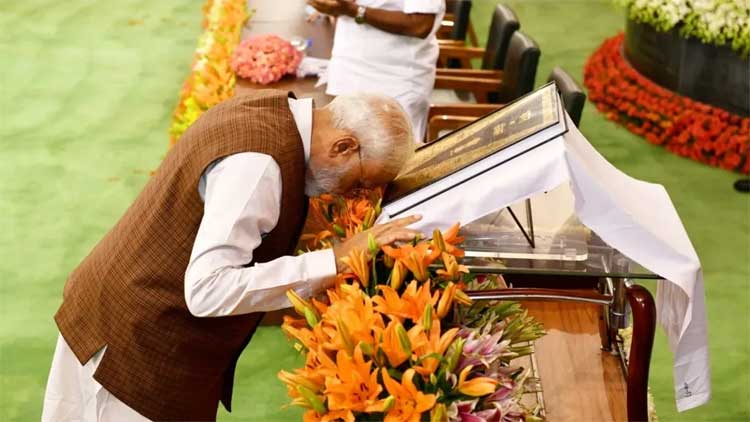
India is observing Constitution Day on November 26, commemorating the adoption of the Constitution by the Constituent Assembly in 1949. On the occasion, Prime Minister Narendra Modi paid tribute to Dr BR Ambedkar and other members of the Constituent Assembly, describing the Constitution as the guiding force behind India’s democratic journey.
In an article published to mark the occasion, Modi raised several politically significant issues, criticising previous governments over the Emergency, constitutional amendments, the dismissal of elected state governments and the erstwhile special status of Jammu and Kashmir.
The Prime Minister also highlighted women’s representation in legislatures, reservation, the role of the Opposition in a parliamentary democracy and India’s ambition of becoming a developed nation by 2047. He accused Opposition parties of obstructing legislation aimed at ensuring adequate representation for women in legislative bodies.
“I assure the Nari Shakti of India that no force can prevent us from ensuring that justice is done to them,” Modi wrote.
PM Modi recalls adoption of Constitution
November 26, 2026, marks the 77th anniversary of the adoption of the Indian Constitution. The day is observed annually as Constitution Day to recognise the contribution of the Constituent Assembly and reaffirm the democratic principles enshrined in the country’s founding document.
Remembering Dr Rajendra Prasad, Dr BR Ambedkar and other members of the Assembly, Modi said the Constitution reflected India’s civilisational heritage while establishing the institutional framework of a modern democracy.
He emphasised that the Constitution should not remain confined to Parliament and the judiciary but should become an integral part of citizens’ everyday lives.
The Prime Minister also recalled his government’s decision, more than a decade ago, to designate November 26 as Constitution Day. He said the initiative was intended to increase awareness about constitutional values, particularly among younger generations, and strengthen their connection with the country’s democratic traditions.
“For a nation as diverse as Bharat — with its numerous faiths, languages, customs and schools of thought — it is important that the Constitution has a resonance far beyond the precincts of Parliament and the courts. Our endeavour has been to deepen its connect with the collective consciousness of our people, especially our youth and strengthen the spirit of unity essential to India’s bright future. That is why over a decade ago, our government decided to mark November 26 as Constitution Day,” the Prime Minister wrote.
PM Modi criticises previous governments over Emergency and constitutional amendments
A major part of Modi’s article focused on constitutional amendments introduced during the early years after Independence and the Emergency imposed in 1975.
Referring to the First Constitutional Amendment of 1951, the Prime Minister alleged that the government at the time had used its majority in the Provisional Parliament to restrict fundamental freedoms despite not having received a direct electoral mandate.
He also questioned the timing of the amendment, which was introduced just months before India’s first general elections. According to Modi, the move was intended to influence the electoral process and suppress public opposition.
“This year marks 75 years since the First Amendment of 1951, when a government that was not popularly elected used its majority in the Provisional Parliament to restrict fundamental freedoms. Its timing, barely months before India’s first general election, proves that it was intended to influence the electoral process and stifle public opposition,” he wrote.
The Prime Minister also criticised the 42nd Constitutional Amendment, introduced during the Emergency, arguing that it weakened institutional checks and balances by curtailing judicial review and altering the distribution of powers among constitutional institutions.
“It is also 50 years since the 42nd Amendment at the height of the Emergency. This curtailed judicial review and fundamentally altered the balance of institutional powers,” he added.
Modi urged young Indians to study the 38th and 39th Constitutional Amendments to understand how the constitutional framework was altered during the Emergency.
“I would also urge youngsters to study the 38th and 39th Amendments to know what a power-hungry and anti-constitutional leadership can do,” he wrote.
Article 356 misuse also features in PM Modi’s article
The Prime Minister also targeted previous governments over the alleged misuse of Article 356, which empowers the Centre to impose President’s Rule in states under specified constitutional circumstances.
He accused one political party of repeatedly invoking the provision to dismiss elected state governments, claiming that it had been imposed nearly 100 times. Modi further alleged that one former Prime Minister was responsible for approximately half of these instances.
“The repeated misuse of Article 356 to dismiss elected state governments presents another troubling chapter. One party has the dubious record of imposing Article 356 almost a hundred times, and one former Prime Minister has scored a half-century in this field,” he said.
The Prime Minister argued that governments entrusted with protecting the Constitution had, on several occasions, weakened its principles.
“There have been occasions in our history when those entrusted with upholding the Constitution chose to weaken it. Ironically, they are the same people who had the opportunity to govern India for five decades,” he wrote.
PM Modi invokes Articles 370 and 35A, recalls J-K’s special status
Another key issue addressed in the article was Jammu and Kashmir’s erstwhile special constitutional status under Articles 370 and 35A.
Modi argued that these provisions had prevented the complete implementation of the Indian Constitution in the region for more than seven decades. He said the arrangement had affected the constitutional rights of Scheduled Castes, Scheduled Tribes, Other Backward Classes and women in Jammu and Kashmir.
Describing the Centre’s 2019 decision to withdraw the region’s special status as the correction of a historical wrong, the Prime Minister wrote:
“The makers of our Constitution had hoped that it would be implemented in letter and spirit across India. But, for over 70 years, Articles 370 and 35A did not allow the full Constitution to be implemented in Jammu and Kashmir, thus trampling over the rights of SC, ST, OBC communities and women. It was only in 2019 that this historical wrong was corrected.”
Article 370 was effectively abrogated in August 2019 through a series of constitutional and parliamentary measures. The erstwhile state of Jammu and Kashmir was subsequently reorganised into two Union Territories — Jammu and Kashmir and Ladakh.
Women’s reservation and Opposition’s role in democracy
Women’s political representation featured prominently in the Prime Minister’s Constitution Day message. Modi highlighted the contribution of women to the making of the Constitution and said their role in India’s democratic journey deserved greater recognition.
He accused Opposition parties of obstructing legislation intended to secure adequate representation for women in legislative bodies. According to the Prime Minister, political empowerment of women was essential to achieving constitutional justice and equality.
“I assure the Nari Shakti of India that no force can prevent us from ensuring that justice is done to them,” he wrote.
Modi also underlined the importance of the Opposition in a parliamentary democracy, arguing that political parties should contribute through constructive criticism rather than disrupting legislative proceedings.
Reservation, including the political debate over OBC representation, also featured in his remarks, with the Prime Minister criticising the Opposition’s position on the issue.
PM Modi reiterates vision of Viksit Bharat by 2047
Concluding his message, Modi linked the importance of constitutional values with India’s ambition of becoming a developed nation by 2047, when the country will mark 100 years of Independence.
He called for a collective commitment to national development, emphasising that the Constitution should guide both governance and citizens’ responsibilities.
The Prime Minister said the principles of putting India first and prioritising duties must remain central to the country’s journey towards becoming a developed nation.
In a separate post on X, Modi extended Constitution Day greetings to citizens and paid tribute to Dr BR Ambedkar and the members of the Constituent Assembly.
“The gift they gave us in the form of the Constitution is a priceless legacy of Indian democracy, which will continue to guide us in fulfilling our resolve to build a developed India,” he said.
Comments are closed.