After NATO Deal, How Far Will the EU Go to Secure Trade Peace with Trump?

Related Posts
Recover your password.
A password will be e-mailed to you.

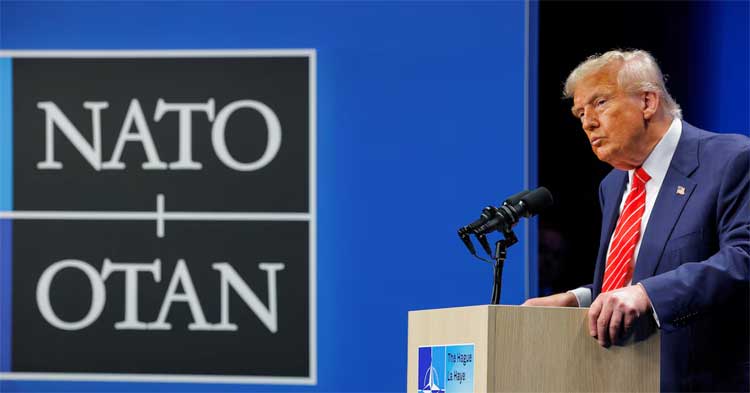
After addressing Donald Trump’s demands for greater European defense spending within NATO, EU leaders on Thursday shifted focus to a more pressing economic threat: looming US tariffs. With a July 9 deadline fast approaching, Brussels is scrambling to finalize a trade deal with Washington that could shield European goods from sweeping import duties.
Negotiations have been ongoing for weeks, led by the European Commission, but progress remains uncertain. If no deal is reached, punitive tariffs could automatically take effect, significantly impacting European exports.
Following a summit of all 27 EU leaders, French President Emmanuel Macron voiced support for a swift deal, though not “at any cost.” Germany’s Chancellor Olaf Scholz has signaled even more urgency, reportedly willing to accept a partially unfavorable outcome to avoid full-blown trade tensions. “It’s better to act quickly and simply than slowly and in a highly complicated way,” said CDU leader Friedrich Merz.
The EU has offered a zero-tariff proposal, but it’s considered unrealistic in Washington. Commission President Ursula von der Leyen confirmed that a fresh US counteroffer had just arrived and was under review.
According to diplomats, the strategy now is to craft a face-saving deal for Trump without sacrificing core European industries. One floated option is a so-called “Swiss cheese” agreement — allowing general US tariffs but with exemptions for key sectors like autos, steel, aerospace, and pharmaceuticals.
Such a deal would be less painful than the current reality, where European exports to the US already face tariffs of 25% on steel and aluminum, and 10% on most other goods. Talks have recently intensified, with Thursday’s EU summit dinner focused on setting negotiators’ boundaries.
Friedrich Merz criticized the EU’s complex approach and urged prioritizing a few critical industries to fast-track an agreement.
If no compromise is reached, tariffs could double to 20% or even reach the 50% level Trump has previously floated. While White House Press Secretary Karoline Leavitt hinted at the possibility of extending the July deadline, she said any decision rests with the president.
Unlike China or Canada, the EU has refrained from retaliating against past US tariffs, preferring to seek resolution through talks. Belgian Prime Minister Bart De Wever emphasized the need to stay composed and avoid triggering a trade war.
But unity is fragile. EU leaders remain divided over how to handle Trump. Hungary’s Viktor Orban and Italy’s Giorgia Meloni openly support him, while others remain skeptical of the former US president’s motives.
“The problem is that we have a heavyweight dealmaker on the US side and lightweight negotiators on ours,” Orban said bluntly.
Northern EU nations, reliant on trade, are particularly wary of escalation. Although Brussels has prepared a retaliatory tariff package targeting US goods worth up to €100 billion, it has kept that threat muted since May.
The US is also pressing the EU to ease regulations on digital services, content, and AI — areas where Washington argues that European laws unfairly disadvantage American tech giants like Apple, Google, and Meta. Brussels is open to discussing shared standards but insists its digital regulatory framework is non-negotiable.
As the clock ticks down, leaders on both sides of the Atlantic are trying to thread a needle — avoiding economic disruption while saving face politically. Whether that’s possible before July 9 remains to be seen.
Dr. Sanjeev Dev Malik- an exceptionally skilled award winner Sr. League Journalist, He is Editor in Chief of four online Indian News & Media Channels and he also writes on International affairs for a plethora of International online News Channels and Has conducted interviews with Diplomats i.e Ambassadors of various countries to India
Recover your password.
A password will be e-mailed to you.
Comments are closed.