
Article 370 anniversary spotlights growing development divide between J&K and PoK

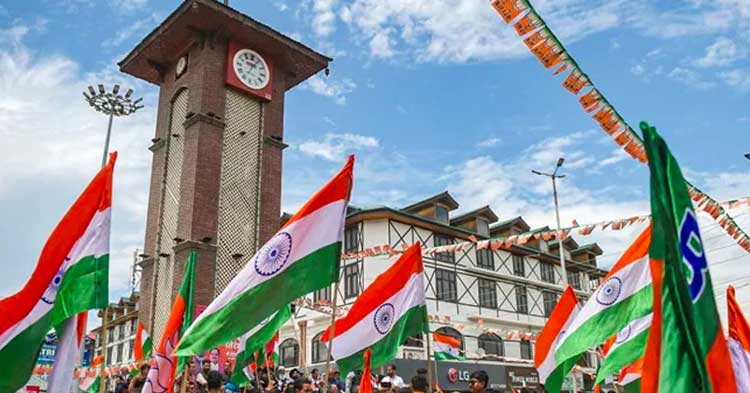
Every year on August 5, India and Pakistan present sharply different narratives on Jammu and Kashmir. While the Modi government marks the anniversary of the abrogation of Article 370 as a milestone in integration and development, Pakistan observes “Youm-e-Istehsal” (Day of Exploitation), portraying the move as an act of suppression. Beyond the political rhetoric, the contrasting economic and infrastructure trajectories on either side of the Line of Control (LoC) have become increasingly evident.
Since 2019, Jammu and Kashmir has witnessed significant investment in connectivity, infrastructure and economic development. Projects such as the Chenab Rail Bridge, expanded highway networks and improved airport infrastructure have strengthened the region’s integration with the rest of India. Supporters of the government’s approach argue that these initiatives have improved logistics, encouraged investment and enhanced tourism.
Official estimates project Jammu and Kashmir’s Gross State Domestic Product (GSDP) at around ₹2.65 lakh crore (approximately $30 billion) in 2024-25, with real growth of over 7%. Tourism has also rebounded strongly, with more than 2.3 crore visitors in recent years, contributing to employment, hospitality and related sectors. The region has also seen growth in digital infrastructure, industrial policy initiatives and startup activity.
In contrast, Pakistan-occupied Kashmir (PoK) continues to face infrastructure and economic challenges. The region lacks railway connectivity and depends largely on road networks. While major projects under the China-Pakistan Economic Corridor (CPEC), including the Karakoram Highway, pass through the area, critics argue that the benefits for local communities have remained limited.
PoK’s economy is estimated to be significantly smaller than that of Jammu and Kashmir and remains closely tied to Pakistan’s broader economic difficulties. Hydropower projects such as Mangla and Neelum-Jhelum contribute substantially to Pakistan’s electricity supply, yet residents have frequently complained of prolonged power outages, rising tariffs and limited local benefits.
The region has also witnessed protests in recent months over inflation, electricity prices and shortages of essential commodities. Reports of clashes between protesters and security forces have drawn attention to growing public discontent, although independent verification of casualty figures has been complicated by communication restrictions.
Analysts say the contrast extends beyond economics to governance and public services. Jammu and Kashmir has seen investments in disaster management systems, climate-resilient infrastructure and public services, while observers argue that PoK continues to struggle with limited administrative and fiscal capacity to respond effectively to natural disasters and infrastructure challenges.
The differing trajectories of the two regions have become central to the competing narratives advanced by India and Pakistan. For New Delhi, infrastructure expansion and economic growth are presented as evidence of successful integration, while Islamabad continues to focus on the political and constitutional dimensions of the Kashmir dispute. The contrasting realities on either side of the LoC are likely to remain a key feature of the debate in the years ahead.
Comments are closed.