
Drums, costumes and loud calls for action as climate protesters mobilize on the road to COP30

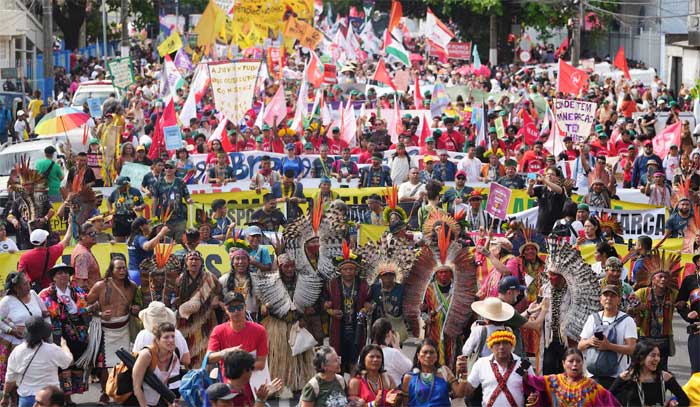
Some protesters donned black dresses to symbolize a “funeral” for fossil fuels. Hundreds more wore red shirts, representing the blood of colleagues who risk their lives to defend the environment. Others chanted, waved enormous flags, and held signs during what has become the largest demonstration at the midway point of the annual United Nations climate summit.
Organizers, perched atop trucks fitted with booming sound systems, coordinated a diverse coalition of environmental and social justice groups. Marisol Garcia, a Kichwa woman from Peru leading one contingent, said demonstrators were pushing world leaders to make “more humanized decisions.”
The march covered roughly 4 kilometers (about 2.5 miles), passing near the main venue of the COP30 talks. Earlier this week, protesters twice disrupted the conference by surrounding the site, including a Tuesday incident in which two security guards sustained minor injuries.
Inside the venue on Saturday, negotiators were scheduled for a full day of sessions, including discussions on implementing the $300 billion per year in climate finance that wealthy nations agreed last year to provide to developing countries. The funding is meant to help poorer nations transition away from fossil fuels, adapt to a hotter, harsher climate, and recover from extreme weather disasters.
Many participants celebrated the ability to protest openly—something far more restricted at recent climate summits in Azerbaijan, the United Arab Emirates, and Egypt. Thousands joined Saturday’s procession, which stretched nearly the entire length of the route.
Youth activist Ana Heloisa Alves, 27, said it was the largest climate march she had ever witnessed. “This is incredible,” she said. “You can’t ignore all these people.” She attended to highlight threats to the Tapajós River, which Brazil’s government hopes to develop commercially. Her group carried signs declaring, “The river is for the people.”
Pablo Neri, a coordinator in Pará state for the Movimento dos Trabalhadores Rurais Sem Terra, said the COP organizers should engage a broader range of voices to reflect a climate movement increasingly powered by grassroots participation.
The United States—whose president, Donald Trump, has dismissed climate change as a “scam” and withdrawn from the 2015 Paris Agreement—is absent from this year’s talks.
Some demonstrators used satire to make their point. Flavio Pinto of Pará wore a brown suit, an oversized American-flag top hat, and walked on stilts while fanning himself with fake $100 bills printed with Trump’s face. His sign read, “Imperialism produces wars and environmental crises.”
Others highlighted local struggles. Vitoria Balbina, a regional coordinator for the Interstate Movement of Coconut Breakers of Babaçu, marched with women wearing dome-shaped hats woven from Babaçu palm fronds. They called for greater access to privately owned palm trees that are central to both their livelihoods and cultural identity. For her, the march represented not only environmental resistance but also “a way of life.”
As the crowd climbed a hill, a vivid sea of red, white, and green flags unfurled behind them. Onlookers gathered outside a corner supermarket to snap photos. “Beautiful,” murmured a man carrying grocery bags as the procession passed.
The climate talks continue through Friday. While analysts and some delegates say they do not expect major new agreements, many hope for movement on longstanding commitments, including funding to help poorer countries adapt to climate impacts.
Comments are closed.