
EU opens next phase of Ukraine membership talks, but hurdles to joining remain

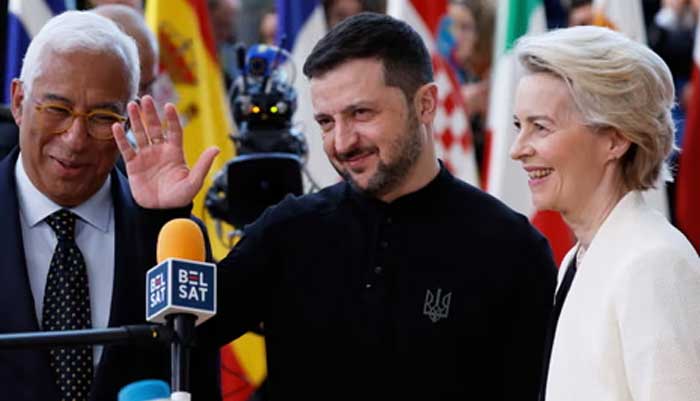
The European Union on Monday formally advanced Ukraine’s long-stalled bid to join the bloc by launching negotiations on the first cluster of EU laws, marking a significant political milestone despite lingering doubts over how quickly Kyiv can achieve full membership.
Foreign ministers from the 27-member bloc officially opened talks with Ukraine and neighboring Moldova on aligning their legislation with key areas of EU law, ending a two-year impasse that had been largely caused by opposition from Hungary’s nationalist leader Viktor Orban.
The breakthrough came after Orban’s defeat in April elections by rival Peter Magyar, clearing the way for progress in accession talks.
“This is a recognition of the determination, courage and hard work shown by both countries in advancing reforms, even in the face of immense challenges,” European Commission President Ursula von der Leyen and European Council President Antonio Costa said in a joint statement.
“In a world marked by growing uncertainty, a larger European Union is in our common interest.”
Despite the symbolic importance of the move, Ukraine still faces a lengthy and complex road to membership. Kyiv must negotiate and implement reforms across 35 chapters covering areas ranging from agriculture and environmental standards to justice, security and governance.
The process is divided into six negotiating clusters and requires unanimous approval from all EU member states at multiple stages, giving any government the ability to delay or block progress.
“This is a long process. Ukraine is at war. It has organized crime issues to solve. It would be the third biggest country in the EU,” a European diplomat told AFP. “The prospect of Ukraine enlargement happening soon never was realistic.”
Even with talks moving forward, political obstacles remain. Magyar has already pledged to hold a referendum on Ukrainian membership if accession negotiations are completed within the next decade or more.
Debate grows over alternative models
As Ukraine presses for rapid integration, some European leaders have begun discussing alternatives to full membership.
German Chancellor Friedrich Merz has suggested granting Ukraine “associate member” status without voting rights while it completes the accession process. Kyiv has reacted cautiously, fearing any interim arrangement could become a permanent substitute for full membership.
President Volodymyr Zelensky has repeatedly insisted that Ukraine’s future in the bloc must include full rights and full membership.
At the same time, broader discussions are underway about reforming the EU’s enlargement process. Several member states, including Germany and France, have called for tighter rule-of-law safeguards and possible limits on voting rights for future entrants as the bloc prepares for potential expansion.
With countries across Eastern Europe and the Western Balkans also seeking membership, concerns are growing that a significantly larger EU could become more difficult to govern.
For Ukraine and its allies, however, accession remains a strategic priority. Zelensky said the opening of negotiations provides crucial political and moral support as the country continues to defend itself against Russia’s invasion.
“Ukraine is doing what is necessary, and it is important that the EU is also keeping its word,” he wrote on social media.
Lithuanian Foreign Minister Kestutis Budrys said the EU should be ready to admit Ukraine by 2030 if Kyiv successfully completes the required reforms and negotiations.
“It’s not to say that it’s a guarantee Ukraine will be a member state in 2030,” Budrys said. “But the European Union should be ready for it.”
Comments are closed.