
France Sees Mass Protests as Backlash Grows Against Macron’s Austerity Push

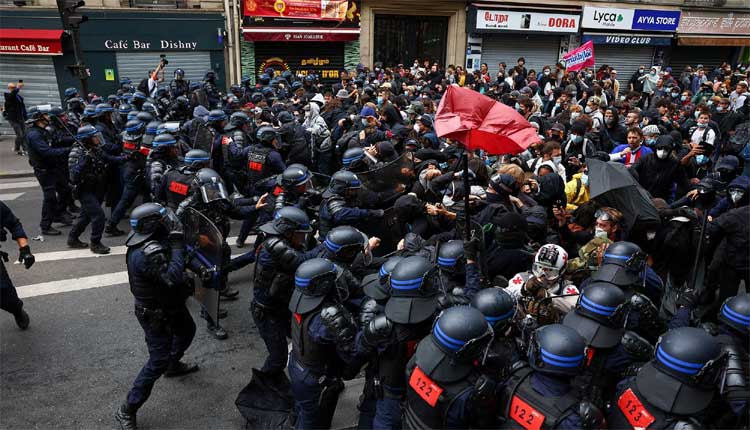
Hospital nurse Aya Touré summed up the mood in Paris on Thursday as she marched with thousands of others through tear gas and police lines: “Fed up. Really, really fed up.”
Across France, strikes and demonstrations disrupted transport, shut down services, and swelled into clashes with police. The unrest, aimed squarely at President Emmanuel Macron and his new prime minister, Sébastien Lecornu, reflects growing fury over planned cuts to public services that many see as the backbone of French life.
Metro lines faltered, buses were blockaded, and striking rail workers even stormed the Finance Ministry for a brief show of defiance. By day’s end, the Interior Ministry reported 181 arrests and more than 450,000 demonstrators nationwide—figures unions claimed were closer to a million.
Protests Over Austerity
Critics accuse Macron of eroding France’s cherished social protections—public hospitals, free education, unemployment support—instead of demanding greater contributions from the wealthy and corporations. “We need to find money where there’s money,” said retired civil servant Pierre Courois. Placards across Paris carried the same message: “Tax the rich.”
For students like Clara Simon, anger runs deep: “There’s already no money for soap in the toilets, no money to fix a seat when it’s broken. The situation is worsening every year.” Nurses and transport workers echoed the same grievances—stagnant wages, staff shortages, and mounting pressure.
Lecornu’s Baptism of Fire
Lecornu, appointed only last week, has tried to show symbolic belt-tightening—cutting lifetime perks for former ministers, scrapping plans to cancel two public holidays—but protesters say he is little more than Macron’s enforcer.
“Bringing in Lecornu doesn’t change anything,” said student Juliette Martin. “He’s just another man in a suit who will follow Macron’s line.”
On his first day in office, Lecornu faced flaming barricades. Thursday’s much larger “Block Everything” campaign was its continuation.
Tense Streets, Heavy Policing
Authorities deployed 80,000 police nationwide, including armored vehicles in Paris. Scuffles flared from dawn, with riot officers firing tear gas to clear blockades. In Nantes, Rennes, and Lyon, similar clashes erupted.
“The bourgeoisie have been gorging themselves, they don’t even know what to do with their money,” said SUD-Rail union leader Fabien Villedieu. “If there’s a crisis, the rich must pay, not the poorest.”
Daily Life Disrupted
Though high-speed trains largely ran, the Paris Metro operated only intermittently. Many commuters were left stranded. “Every time there’s a protest, daily life feels held hostage,” said office worker Nathalie Laurent. “If this is Lecornu’s idea of stability, he has a long way to go.”
Comments are closed.