
Indian Envoy Defends Shelter For Sheikh Hasina: ‘She Was Still Bangladesh PM’

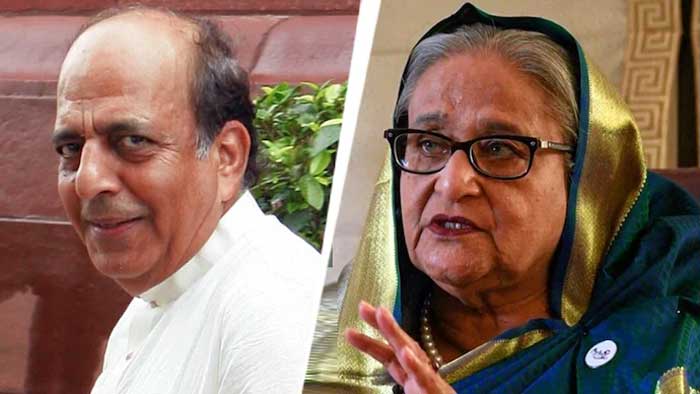
India, as a neighbour, had a duty to provide shelter to former Bangladesh prime minister Sheikh Hasina after she fled the country in August 2024, Indian High Commissioner to Bangladesh Dinesh Trivedi said.
Trivedi said India “hardly had any choice” at the time because Hasina was still Bangladesh’s prime minister. He also clarified that she was not brought to India by the Indian Air Force or Army.
Speaking at the Bay of Bengal Conversation 2026 in Dhaka on Saturday, Trivedi said the decision was driven by the circumstances surrounding the collapse of Hasina’s government.
“At that point in time, she was still the prime minister of Bangladesh. We had hardly any choice on that. It was our duty as a neighbour to accept the reality of life because situations are such where, at times, you are not prepared for it,” Trivedi said.
He questioned what the consequences would have been if India had refused permission for Hasina to enter the country.
Bangladesh Prime Minister Tarique Rahman delivered the opening remarks at the fifth edition of the event but was not present when Trivedi made the comments.
Hasina’s Extradition Remains Under Review
Hasina has been living in India since fleeing Bangladesh after her government collapsed amid student-led protests in August 2024. Her extradition was first sought by the interim administration led by Muhammad Yunus and has since been repeatedly demanded by the Bangladesh Nationalist Party (BNP) government led by Rahman.
Her presence in India has remained a source of tension between the two neighbours, although bilateral ties improved somewhat after Rahman’s government came to power earlier this year.
Dhaka has also objected to interviews given by Hasina while in self-exile. In a recent interview, she announced plans to return to Bangladesh in December, despite facing a death sentence there.
Trivedi said India could not set a deadline for Hasina’s return because the extradition request was being examined through the legal process.
“Nobody can give you a time frame,” he said when asked about Dhaka’s repeated demands for her extradition.
“The government of India has replied again and again that there is a process, and the process is legal, and it is well structured,” he added.
India’s Ministry of External Affairs has repeatedly said Bangladesh’s extradition request is being examined in accordance with established procedures.
‘IAF Did Not Bring Sheikh Hasina To India’
Trivedi also clarified that Hasina was not brought to India by the Indian Air Force or the Indian Army.
A Bangladesh Air Force aircraft flew Hasina to India on August 5, 2024, after a Bangladesh Army-led security team escorted her from her official residence as protesters approached the premises.
Trivedi described the circumstances that led to her departure as “tragic” and said such a situation should never be repeated anywhere in the world.
What Happened After Hasina’s Government Fell
After Hasina’s government was toppled, an interim administration led by Muhammad Yunus took office on August 8, 2024, and governed Bangladesh for roughly a year and a half.
India-Bangladesh relations deteriorated sharply during the Yunus-led interim administration, with tensions centred on Hasina’s extradition, concerns over attacks on minorities and Bangladesh’s growing engagement with China.
In 2025, Hasina was tried in absentia by a special tribunal and sentenced to death. The interim government also dissolved her Awami League party and formally sought her extradition through a diplomatic note.
After taking office following the February 12 election, Rahman’s BNP government endorsed the ban on the Awami League and renewed demands for Hasina’s extradition.
Extradition Issue Continues To Strain Ties
The dispute over Hasina’s extradition has continued to weigh on India-Bangladesh relations and has also complicated Rahman’s proposed visit to New Delhi.
India invited Rahman to attend the BRICS Summit last month and separately extended a bilateral invitation after he assumed office in February. Rahman did not attend the summit and has not visited New Delhi since becoming prime minister.
Bangladesh has said it remains “positive” about progress in discussions over Rahman’s proposed India visit, although no date has been announced.
A virtual press conference held by Hasina from New Delhi on August 5 further increased tensions between the neighbours.
During the event, Hasina said she intended to return to Bangladesh in December and put the country back on the “right track,” despite the possibility of imprisonment or execution.
“I know, they may put me in jail or kill me,” she said, adding that she would return home to be with her people.
In her first telephonic interview with Indian media, Hasina also questioned the BNP government’s decision to link her extradition to a possible visit by Rahman to New Delhi. She said she intended to return home on her own by December.
Speaking to HT from an unspecified location, Hasina also questioned Bangladesh’s decision to acquire combat aircraft from China under a $2.3 billion deal while the country faces electricity and gas shortages, fertiliser shortages and a rising cost of living.
Comments are closed.