
Israel, Lebanon and US sign Hezbollah ceasefire framework; Netanyahu says deal weakens Iran’s influence

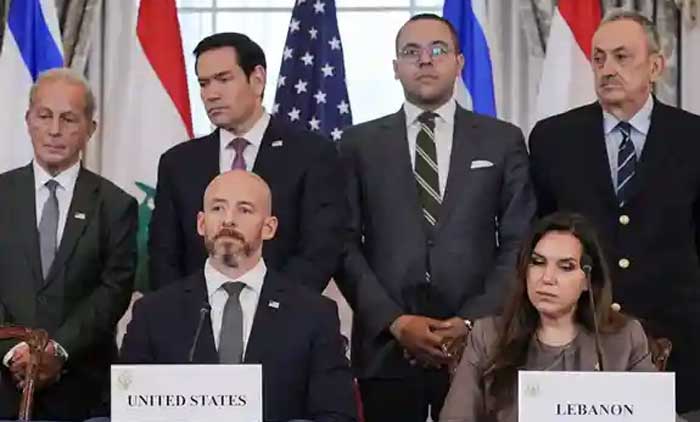
Israel, Lebanon and the United States signed a trilateral framework agreement on Friday aimed at ending the long-running conflict involving Israel and Iran-backed Hezbollah militants, following days of negotiations.
Lebanese Ambassador Nada Moawad and Israel’s envoy Yechiel Leiter signed the agreement alongside US officials at the State Department in Washington.
US Secretary of State Marco Rubio described the deal as a crucial first step toward a difficult but necessary process.
“Today we’ve taken the first step in what will be a difficult journey, without a doubt, but an important and an essential and a necessary one,” Rubio said, adding that “there’s a lot of work ahead.”
The agreement will be carried out through a trilateral Military Coordination Group for Lebanon. Washington also pledged major support, including $100 million in humanitarian assistance coordinated with the United Nations and additional funding to strengthen the Lebanese Armed Forces.
The US said it would provide more than $30 million through existing programs to help Lebanon’s military expand its ability to assert control over the country’s territory.
Israel’s ambassador Yechiel Leiter said the agreement represented a new phase in relations between Israel and Lebanon.
“Under the deal, Iran is out, Hezbollah is out, and the road to peace between Israel and Lebanon is in,” Leiter said.
Lebanon welcomes agreement
Lebanese President Joseph Aoun welcomed the framework, calling it a first step toward restoring full sovereignty over Lebanese territory.
He said the deal would help citizens return to their homes and rebuild communities under the authority of the Lebanese state.
Prime Minister Nawaf Salam also expressed hope that the agreement would lead to the withdrawal of Israeli forces from southern Lebanon and allow reconstruction efforts to begin.
Hezbollah rejects deal
Hezbollah opposed the agreement, warning that enforcing it could create internal conflict in Lebanon.
The group’s lawmaker Hassan Fadlallah said Lebanese authorities would not be able to implement the agreement without risking a civil war, accusing the deal of undermining Hezbollah’s role.
Hezbollah has historically rejected direct negotiations between Israel and Lebanon.
Netanyahu hails ‘major achievement’
Israeli Prime Minister Benjamin Netanyahu called the agreement a “great achievement” but said Israel would keep troops in southern Lebanon until Hezbollah is disarmed and no longer poses a security threat.
“The most important thing, first and foremost, is that Israel will remain in the security zone in southern Lebanon,” Netanyahu said.
He added that Israel was allowing the Lebanese army to prepare to take control of certain areas, including zones south and north of the Litani River.
Netanyahu also said displaced civilians from parts of the so-called security zone would not immediately be allowed to return.
Calling the agreement a major setback for Iran, Netanyahu said Tehran was attempting to pressure Israel into leaving southern Lebanon but insisted that the issue was between Israel, Lebanon and the United States.
Comments are closed.