
Mark Carney says Canada can’t rule out military participation in Iran war

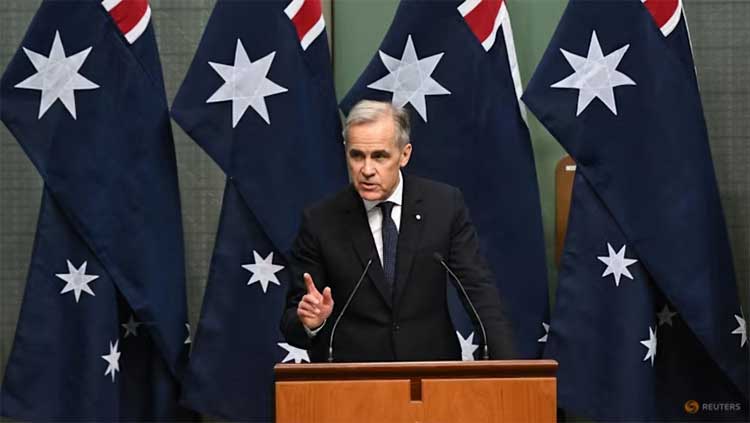
Canadian Prime Minister Mark Carney on Thursday said he could not rule out the possibility of his country’s military involvement in the escalating war in the Middle East.
Carney’s visit to Australia this week has been overshadowed by the widening conflict in the region, triggered by a massive joint strike by the United States and Israel on Iran that killed Iran’s supreme leader, Ayatollah Ali Khamenei.
Speaking alongside Australian Prime Minister Anthony Albanese in Canberra, Carney was asked whether there could be circumstances in which Canada might become involved in the conflict.
“One can never categorically rule out participation,” he said, while stressing that the question was “hypothetical.”
“We will stand by our allies,” Carney added. “And we will always defend Canadians.”
Carney has earlier said the US-Israeli strikes on Iran were “inconsistent with international law.” At the same time, he reiterated Canada’s support for efforts to prevent Iran from acquiring nuclear weapons — a stance he described as being taken “with regret,” calling the situation “another example of the failure of the international order.”
The Canadian leader also renewed his call for a “de-escalation” of the conflict.
His visit forms part of a broader Asia-Pacific tour aimed at reducing Canada’s reliance on the United States, which Carney has described as a hedge against what he sees as a weakening US-led global order.
The Australia leg of the trip is focused on attracting investment and strengthening ties with a like-minded “middle power” partner.
Addressing Australia’s parliament on Thursday, Carney urged so-called “middle powers” to work more closely together in a changing global landscape.
Countries such as Australia and Canada face a stark choice, he said: cooperate to help shape the “new rules” of the global order or allow major powers to dictate them.
“In this brave new world, middle powers cannot simply build higher walls and retreat behind them. We must work together,” he said.
“Great powers can compel, but compulsion comes with costs, both reputational and financial,” the former central banker added.
“Middle powers like Australia and Canada hold this rare convening power because others know we mean what we say and we will match our values with our actions.”
Carney also said the two countries would work together as “strategic collaborators” to harness their combined rare-earth mineral resources and expand cooperation in areas ranging from defence to artificial intelligence.
“We know we must work with others who share our values to build solid capabilities,” he told parliament, warning that otherwise middle powers risk being “caught between the hyperscalers and the hegemons.”
Carney has frequently clashed with US President Donald Trump, who has repeatedly threatened to annex Canada and imposed steep tariffs on the country.
In a speech to global political and financial leaders at the World Economic Forum in January, Carney warned that the US-led global system of governance was experiencing “a rupture.”
Comments are closed.