

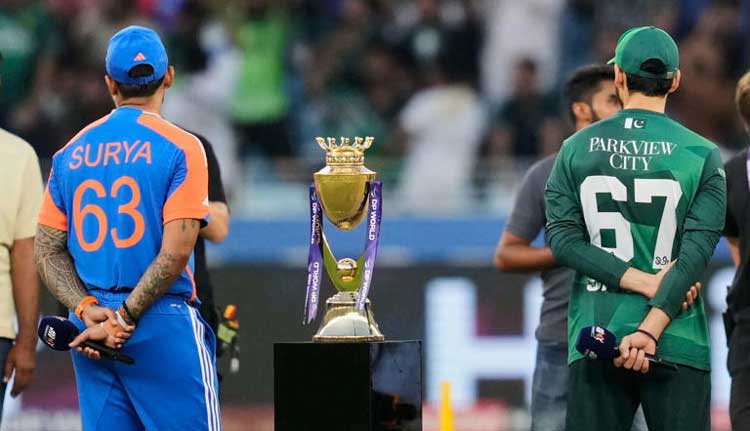
“I feel you should stop asking this question on the rivalry. This is not a rivalry anymore.”
With his trademark smile, Suryakumar Yadav delivered that line in Dubai during the Asia Cup, brushing aside the familiar narrative surrounding India–Pakistan encounters. The remark stirred debate, particularly given India’s dominant head-to-head record in T20Is.
A week later, India strengthened that advantage with another victory, extending their winning run over Pakistan national cricket team. Yet ahead of the latest T20 World Cup meeting, Suryakumar struck a more measured tone.
“That is history,” he said on the eve of the match. “Whoever plays good cricket, the result will be on their side.”
The highly anticipated fixture at R. Premadasa Stadium carries familiar significance. After months of uncertainty and political noise, both sides now turn their focus squarely to cricket, with early tournament momentum and bragging rights at stake.
Similar journeys, contrasting combinations
Both teams have followed comparable paths into the contest, recovering from testing moments to register convincing wins. But their tactical approaches differ.
Pakistan have leaned heavily on spin, fielding multiple slow-bowling options throughout the tournament. India, by contrast, have preferred a more balanced attack with a stronger pace component, though conditions in Colombo could influence selection tweaks.
India’s squad depth offers flexibility, while Pakistan’s spin-heavy strategy has drawn attention — particularly the emergence of Usman Tariq, whose unusual action and deceptive variations have quickly become a talking point.
Despite limited international exposure, Tariq’s distinctive style has prompted India’s batters to simulate his release and rhythm during practice sessions, underlining the respect such novelty commands on the global stage.
Key storylines to watch
For Pakistan, much of the spotlight will fall on Babar Azam, who has recently shifted to a middle-order role. His adaptability and strike rotation could prove decisive in a pressure-filled contest.
India, meanwhile, will weigh selection decisions carefully, balancing player fitness, conditions, and match-ups. Their batting firepower and varied bowling resources position them strongly on paper.
More than numbers
While India may appear favourites numerically, matches between these two sides rarely conform to prediction. Form, atmosphere, and nerves often blur statistical edges.
“This is not just another game,” Suryakumar acknowledged — a sentiment that resonates regardless of debates about rivalry.
With a packed Colombo crowd expected and stakes rising early in the tournament, the stage is set for another chapter in one of cricket’s most emotionally charged contests.
Comments are closed.