

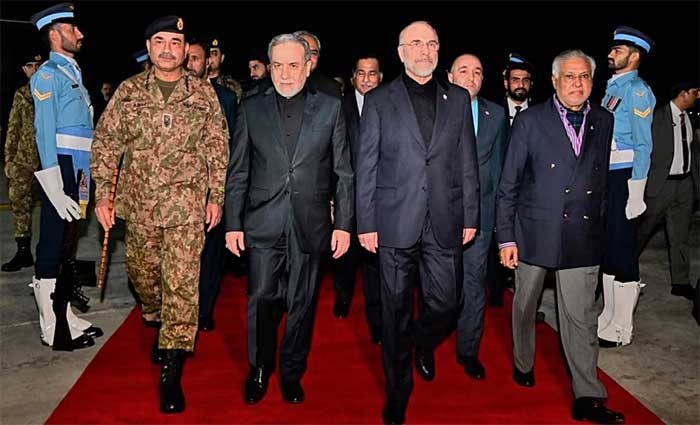
“Goodwill begets goodwill. Enmity begets enmity,” Iran’s Foreign Minister Abbas Araqchi said after marathon talks with Washington collapsed, as Tehran reacted sharply to a US plan to blockade the Strait of Hormuz—a move that risks shattering a fragile ceasefire and escalating the conflict.
Araqchi said Iran had negotiated in good faith but ran into “maximalism, shifting goalposts, and blockade” just short of finalising an “Islamabad MoU,” adding bluntly: “Zero lessons earned.”
His remarks followed an announcement by US President Donald Trump that the US Navy would begin blockading maritime traffic to and from Iranian ports after weekend talks in Islamabad—the first direct US-Iran engagement in more than a decade—ended without a deal.
The United States Central Command said the blockade would take effect at 10 a.m. ET (1400 GMT) on Monday and apply to vessels of all nations entering or leaving Iranian ports along the Arabian Gulf and Gulf of Oman. It added that transit through the Strait for ships not bound for Iran would remain unaffected.
Trump, posting on social media, said Washington would target any vessel paying what he called an “illegal toll” to Iran and would begin clearing mines allegedly laid by Iranian forces in the strategic waterway, through which roughly 20% of global energy supplies pass.
“No one who pays an illegal toll will have safe passage on the high seas,” he said, warning that any Iranian attack on US or commercial vessels would be met with overwhelming force.
Tehran’s response was swift. The Islamic Revolutionary Guard Corps warned that any military vessels approaching the Strait would be treated as a violation of the ceasefire and dealt with “harshly and decisively,” underscoring the risk of further escalation.
Parliament Speaker Mohammad Baqer Qalibaf dismissed Trump’s threats, saying they would not alter Tehran’s position.
“If you fight, we will fight, and if you come forward with logic, we will respond with logic,” he said in remarks carried by state media.
The Islamabad talks followed a ceasefire announced earlier in the week after six weeks of fighting that has killed thousands, rattled global markets and pushed oil prices above $100 per barrel. The Strait of Hormuz remains a central flashpoint, with Iran having previously restricted traffic through the narrow shipping lane.
US Vice President JD Vance, who led the American delegation, said no agreement had been reached, calling the outcome “bad news for Iran much more than it’s bad news for the United States.”
Despite the breakdown, Trump signalled diplomacy could continue, describing the talks as “very friendly” and expressing confidence that Iran would return to negotiations.
“I do believe they’re going to come to the table on this,” he said in an interview.
A US official said major sticking points included Washington’s demand for a complete halt to uranium enrichment, dismantling of enrichment facilities, transfer of highly enriched uranium, an end to Iran’s support for regional groups, and guarantees of full access to the Strait.
Qalibaf, however, blamed Washington for the impasse, saying Iran had offered “forward-looking initiatives” but failed to win US trust. President Masoud Pezeshkian, in a call with Russian President Vladimir Putin, reiterated Tehran’s desire for a “balanced and fair agreement.”
“If the United States returns to the framework of international law, reaching an agreement is not far off,” he said, according to state media.
Iranian outlets, including the semi-official Tasnim news agency, said “excessive” US demands had hindered progress, though some areas reportedly saw convergence, with the Strait and Iran’s nuclear programme remaining the key obstacles.
Amid the rising tensions, shipping data showed three fully laden supertankers transiting the Strait on Saturday—apparently the first to exit the Gulf since the ceasefire—offering a tentative sign that maritime traffic has yet to be fully disrupted despite the looming blockade.
Comments are closed.