Trump Disputes Gabbard on Iran’s Nuclear Intentions, Suggests Israel Strikes ‘Hard to Stop’ Amid Ceasefire Talks

Recover your password.
A password will be e-mailed to you.

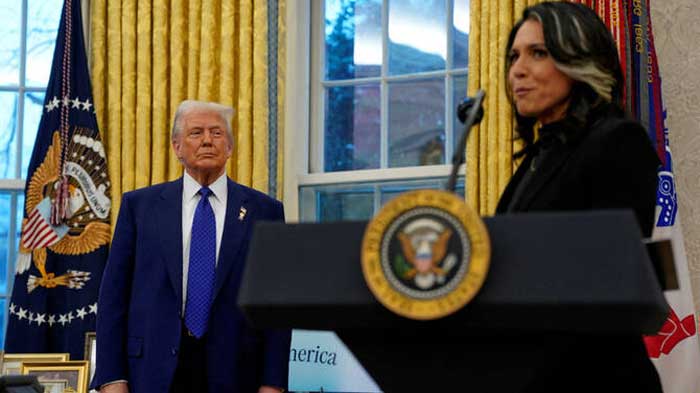
President Donald Trump on Friday contradicted his director of national intelligence, Tulsi Gabbard, over her earlier assertion that U.S. intelligence agencies believed Iran was not actively building a nuclear weapon. He also suggested that halting Israeli strikes on Iran would be difficult, casting doubt on the prospects of a ceasefire and diplomatic breakthrough.
Speaking after arriving in New Jersey for a political fundraiser, Trump was asked about Gabbard’s March testimony before Congress, in which she stated that U.S. intelligence assessments found no evidence Iran was pursuing nuclear warheads. Trump replied bluntly, “Well then, my intelligence community is wrong. Who in the intelligence community said that?” When informed it was Gabbard, he responded, “She’s wrong.”
Gabbard later clarified her remarks in a post on X, saying they had been taken out of context. She reaffirmed her alignment with Trump’s view, writing: “America has intelligence that Iran is at the point that it can produce a nuclear weapon within weeks to months, if they decide to finalize the assembly. President Trump has been clear that can’t happen, and I agree.”
The disagreement comes amid rising tensions and internal deliberations within the White House over potential U.S. military intervention in the Israel-Iran conflict. The Biden administration said Thursday that Trump would take up to two weeks to decide whether to involve American forces, citing the possibility of renewed negotiations with Tehran.
However, Trump cast skepticism on any diplomatic off-ramp. Speaking to reporters, he said calls for a ceasefire would be difficult to implement given the current battlefield dynamics. “It’s very hard to stop,” he said of Israeli strikes on Iran. “Israel’s doing well in terms of war. And I think you would say that Iran is doing less well. It’s a little bit hard to get somebody to stop.”
When asked whether he would pressure Israel to pause strikes to facilitate talks, Trump responded, “I think it’s very hard to make that request right now. If somebody is winning, it’s a little bit harder to do than if somebody is losing.”
Despite his long-standing promise to end “forever wars” and his past criticism of U.S. interventions like the Iraq War, Trump defended his current hardline approach toward Iran as a necessary response to a more dangerous nuclear threat. Comparing today’s situation to the pre-2003 Iraq era, he said, “There were no weapons of mass destruction. I never thought there were. And that was somewhat pre-nuclear. You know, it was a nuclear age, but nothing like it is today.”
On Iran’s claim that its nuclear program is for peaceful purposes such as energy production, Trump expressed strong skepticism. “You’re sitting on one of the largest oil piles anywhere in the world,” he said. “It’s a little bit hard to see why you’d need that.”
Trump also suggested that intelligence now confirms Iran has amassed a “tremendous amount” of nuclear material, reinforcing his argument that the threat is both urgent and real — and possibly justifying continued Israeli strikes.
While maintaining that the U.S. remains open to talks, Trump’s rhetoric signaled that de-escalation may not be imminent. “We’re ready, willing and able, and we’ve been speaking to Iran, and we’ll see what happens,” he said.
Dr. Sanjeev Dev Malik- an exceptionally skilled award winner Sr. League Journalist, He is Editor in Chief of four online Indian News & Media Channels and he also writes on International affairs for a plethora of International online News Channels and Has conducted interviews with Diplomats i.e Ambassadors of various countries to India
Recover your password.
A password will be e-mailed to you.
Comments are closed.