
US-Iran strikes deepen crisis as fragile ceasefire faces fresh challenge over Strait of Hormuz

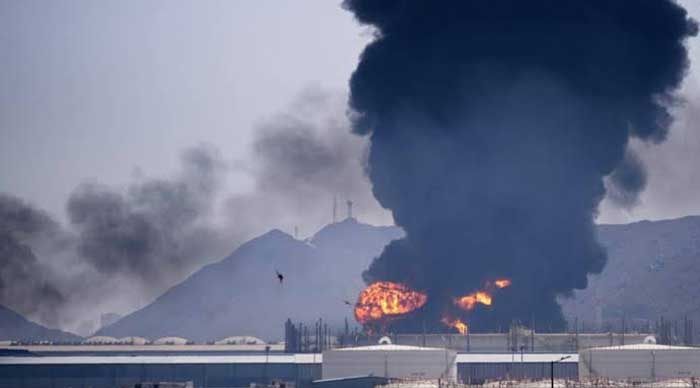
The United States and Iran exchanged new military strikes on Saturday, escalating tensions and putting a fragile ceasefire and ongoing talks over security in the Strait of Hormuz at risk.
Iran’s Islamic Revolutionary Guard Corps (IRGC) claimed it had targeted US military positions in the region in response to what it called a fresh American attack on Iranian territory.
“The response to a fresh US attack against Iran will be swift and decisive,” the IRGC said in an earlier statement carried by Iran’s semi-official ISNA news agency, which was later removed. The force did not reveal details about the locations of the alleged US targets.
The latest confrontation followed US strikes on Friday against Iranian missile and drone storage facilities as well as coastal radar sites. The US Central Command said the operation was carried out in retaliation for an Iranian drone strike on the Singapore-flagged cargo ship Ever Lovely while it was leaving the Strait of Hormuz through a UN-supported temporary shipping corridor.
“The unwarranted aggression against commercial shipping by Iranian forces clearly violated the ceasefire,” US Central Command said in a statement, adding that Iran’s actions threatened freedom of navigation through a key global trade route.
Iranian media reported that a projectile hit the area near a pier in Sirik, southern Iran, following the US strikes.
‘Foolish violation’ of ceasefire
US President Donald Trump condemned the attack on the cargo vessel, claiming that one Iranian drone struck the ship’s upper deck while three others were intercepted.
“Obviously, this is a foolish violation of our Ceasefire Agreement,” Trump wrote on his Truth Social platform.
Speaking at the White House before the retaliatory strikes, Trump said he was unhappy that Iran had carried out the attack despite the ceasefire.
When asked why the US was launching military action while negotiations with Tehran were still underway, Trump said Iran was “a little bit different” before ending the interaction with reporters.
A US official told The Associated Press that strikes on Iranian targets continued even after Central Command announced the operation.
Dispute over Strait of Hormuz
The escalation comes as Washington and Tehran attempt to negotiate a long-term agreement under an interim deal reached last week.
Iran has increasingly asserted control over the Strait of Hormuz, a critical waterway through which about one-fifth of the world’s oil supplies pass.
Ebrahim Azizi, head of Iran’s parliamentary national security commission, defended Tehran’s position, saying the strait was under Iranian authority and urging others to follow its rules.
He described Iran’s actions as “ceasefire management” rather than a breach of the truce.
Iranian Deputy Foreign Minister Kazem Gharibabadi also warned Gulf countries against supporting Washington after the US and six Gulf states rejected Tehran’s claim that it could impose charges on vessels using the waterway.
“Safe passage through the Strait of Hormuz cannot be guaranteed under ambiguous arrangements,” Gharibabadi said, arguing that Iran’s role as a coastal state must be considered.
Iranian state media also reported that three foreign oil tankers attempting what it called an “unauthorized passage” through the strait were turned back after warnings from the IRGC.
A US official said Washington was aware of the reports and was investigating, while reiterating that Iran could not disrupt international maritime traffic.
Shipping fears grow
The attack on the Ever Lovely came as the International Maritime Organization (IMO) was working to move hundreds of stranded ships out of the Strait of Hormuz through an alternate route along Oman’s coast.
The UN maritime agency halted the evacuation operation after the attack, saying it would not restart until ships were assured of safe passage.
IMO Secretary-General Arsenio Dominguez said around 115 vessels had already exited the strait, while nearly 500 remained in the region.
The alternative route was expected to reduce pressure on global markets and weaken Iran’s leverage in negotiations with the United States.
Talks between Washington and Tehran are continuing under a 60-day interim agreement aimed at resolving disputes over maritime security and Iran’s stockpile of highly enriched uranium.
However, the latest exchange of strikes has raised new concerns over whether the ceasefire can survive long enough for both sides to reach a permanent agreement.
Comments are closed.