

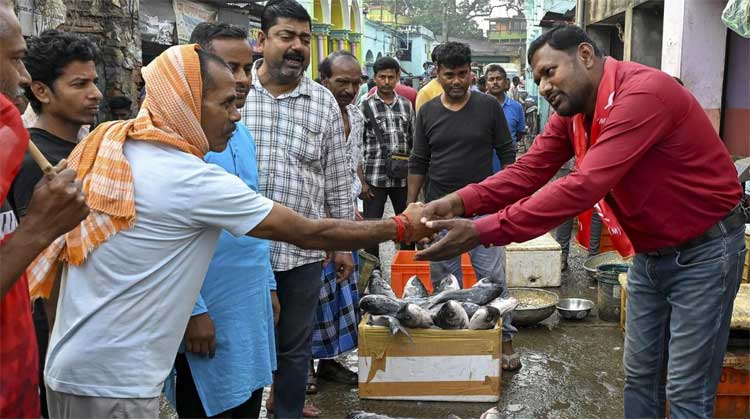
At lunchtime in Dacre’s Lane — the narrow stretch of food stalls tucked behind Esplanade in Kolkata — the routine appears unchanged. Office-goers crowd around plates of chicken stew and rice, tea flows endlessly into small glasses, and cigarettes pass quickly between fingers.
But as West Bengal heads into polling on April 23 and 29, something in the conversations has shifted.
Political debates are still everywhere — as they always are during elections — but the tone feels different this time. Instead of loud assertions, discussions unfold in lowered voices, cautious phrases and unfinished thoughts. The contest between the Trinamool Congress (TMC) and the Bharatiya Janata Party (BJP) remains central, yet many stop short of declaring where they stand.
“It’s very difficult to say,” said Bardesh Paswan, a worker at the iconic Chitto Babur Dokan, a decades-old eatery in Dacre’s Lane. “What is inside you, you understand; what is inside me, I understand. Nobody wants to reveal it publicly.”
His words echo a broader sentiment across central Kolkata: people are watching closely, but speaking less.
“Everyone wants change. Everyone wants to feel better,” he added. “The person earning ₹100 a day wants peaceful sleep, and so does the one earning ₹1,000. But are people really getting that?”
Confidence, but with caution
Not everyone is hesitant. At Office Para, Saurabh Pandit voiced clear support for Chief Minister Mamata Banerjee.
“Jai Bangla, Mamata Banerjee. No doubt,” he said. “Politics should not be about religion — it should be about work. Some work is done, some is incomplete. You have to give time.”
Yet even among supporters, the focus quickly returns to governance — queues for services, documentation challenges, and everyday struggles.
Pandit also raised concerns over the Election Commission’s Special Intensive Revision (SIR) exercise, questioning the timing and feasibility of adding millions of voters so close to polling.
“Why is everything a queue? How long will people keep standing in lines?” he asked, reflecting frustrations that go beyond party lines.
A few steps away, Anutapo Sanyal summed up the uncertainty many feel.
“It’s difficult to say right now,” he said. “There is some doubt about whether the ruling party will continue. We’ll have to wait and see.”
On whether the BJP still carries an “outsider” tag in Bengal, he was more direct: “This is India. I don’t think the BJP should be seen as an outsider.”
A guarded mood in markets
In the New Market area, traders echoed the same caution.
“Right now everyone is silent. Nobody talks openly,” said VM Shukla. “People who speak clearly are hardly one or two percent.”
Asked what voters want, his answer avoided politics altogether: “Protection. A better environment. Business should run well.”
Whether the TMC will return to power, he paused: “Anything can happen this time.”
Welfare vs aspiration
On Park Street, another layer of the electoral mood emerges. Rani Jana, speaking from the iconic eatery Mocambo, pointed to the continued appeal of welfare schemes like Lakshmi Bhandar among women voters.
“People are excited about it,” she said.
But she also flagged a contrasting sentiment among younger voters. “There is a feeling for change because of unemployment and lack of opportunities,” she noted, adding that outside Kolkata, support for the TMC remains strong — making it difficult for the BJP to make deep inroads.
A city watching, but not speaking
Across Dacre’s Lane, New Market and Park Street, one pattern stands out: conversations revolve less around political rivalry and more around livelihood, safety and stability.
There is neither a clear wave for change nor an overwhelming endorsement of the incumbent. Instead, Kolkata’s electorate appears to be in a phase of quiet calculation.
“What does the common public want?” one trader asked. “Food, peace, love and respect.”
Throughout the day, many people declined to speak on record or on camera. Some admitted privately that openly expressing political views could invite trouble, hinting at an undercurrent of fear.
The mood, at least in parts of Kolkata, is not loud or overtly polarised — but cautious, watchful and restrained.
In the city’s addas this election season, certainty is scarce. Conversations continue, but often in whispers — revealing an electorate that is weighing its choices carefully, even as the West Bengal Assembly Elections 2026 approach.
Comments are closed.