
12 Places That Reveal the Dramatic Impact of Climate Change on Earth

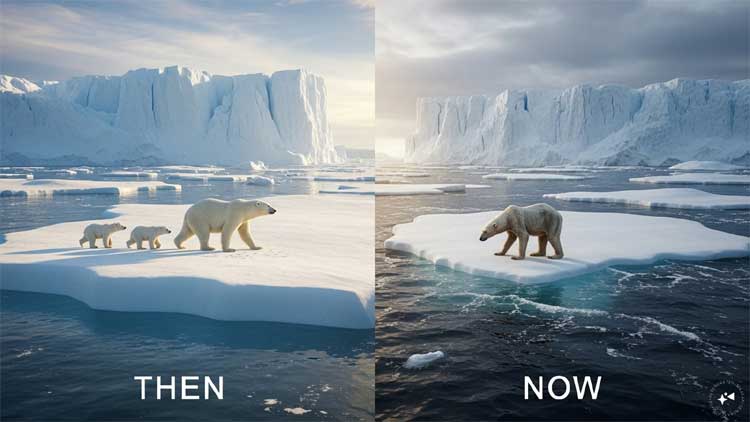
Climate change is no longer a distant threat discussed only in scientific reports. Its effects are visible across the globe, reshaping landscapes, ecosystems, and communities at an alarming pace. From disappearing glaciers and shrinking lakes to sinking coastlines and bleached coral reefs, global warming has left unmistakable marks on some of Earth’s most iconic locations.
The following 12 places offer striking examples of how climate change has transformed the planet over recent decades.
1. Arctic Sea Ice, Arctic Ocean
Before: For centuries, vast expanses of thick sea ice covered the Arctic Ocean year-round, supporting polar bears, seals, and indigenous communities.
After: Rising temperatures have dramatically reduced Arctic sea ice. Summer ice coverage has shrunk by nearly half since satellite monitoring began in 1979, exposing darker ocean waters that absorb more heat and accelerate warming.
2. Jakobshavn Glacier, Greenland
Before: Greenland’s glaciers remained relatively stable for thousands of years, storing massive amounts of freshwater in frozen form.
After: Jakobshavn Glacier, one of the world’s fastest-moving glaciers, has retreated significantly as warming temperatures accelerate ice melt. Greenland’s ice sheet is now one of the largest contributors to global sea-level rise.
3. Great Barrier Reef, Australia
Before: The Great Barrier Reef was renowned for its vibrant coral ecosystems, supporting thousands of marine species.
After: Repeated marine heatwaves have triggered widespread coral bleaching events. Large sections of the reef have lost color and biodiversity, threatening one of the planet’s most important marine ecosystems.
4. Glacier National Park, United States
Before: When the park was established in 1910, it contained more than 150 glaciers.
After: Today, fewer than 30 glaciers remain large enough to be considered active. Scientists warn that many could disappear entirely within decades if warming continues.
5. Lake Chad, Africa
Before: Lake Chad was once among Africa’s largest freshwater lakes, sustaining millions of people across Chad, Nigeria, Niger, and Cameroon.
After: The lake has shrunk dramatically due to a combination of climate change, prolonged droughts, and increasing water demand, creating severe challenges for local communities and agriculture.
6. The Alps, Europe
Before: Europe’s iconic mountain range was characterized by extensive snow cover and massive glaciers that attracted tourists and supported water supplies.
After: Alpine glaciers have retreated rapidly over the past century. Snow seasons have become shorter, affecting tourism, ecosystems, and freshwater availability across the continent.
7. Mount Kilimanjaro, Tanzania
Before: Africa’s highest peak was crowned with extensive ice fields and glaciers visible from miles away.
After: More than 80 percent of Kilimanjaro’s ice cover has disappeared since the early 20th century. Scientists warn that the remaining ice could vanish within decades.
8. Venice, Italy
Before: Seasonal flooding occurred occasionally but remained manageable for the historic city.
After: Rising sea levels and increasingly frequent storm surges have intensified flooding events. The city now relies on massive flood-barrier systems to protect its cultural heritage and residents.
9. The Amazon Rainforest, South America
Before: The Amazon acted as one of the world’s most important carbon sinks, absorbing vast amounts of atmospheric carbon dioxide.
After: Rising temperatures, droughts, and deforestation have weakened parts of the rainforest’s ability to absorb carbon. Some regions are now emitting more carbon than they store.
10. The Maldives
Before: The low-lying island nation thrived on pristine beaches and stable coastlines.
After: Sea-level rise has increased coastal erosion and flooding risks. Many islands face an uncertain future as climate change threatens their long-term habitability.
11. Permafrost Regions of Siberia, Russia
Before: Vast stretches of permanently frozen ground locked away enormous quantities of carbon and methane.
After: Rising temperatures are causing permafrost to thaw, damaging infrastructure and releasing greenhouse gases that further intensify global warming.
12. Tuvalu, Pacific Ocean
Before: This small island nation maintained stable coastlines and freshwater resources for generations.
After: Rising seas, saltwater intrusion, and coastal erosion are threatening homes, agriculture, and freshwater supplies. Tuvalu has become a symbol of the existential risks faced by low-lying nations.
A Planet in Transition
The transformation of these 12 locations illustrates the far-reaching consequences of climate change. While each place faces unique challenges, they share a common reality: rising temperatures are altering Earth’s natural systems at unprecedented speed.
Scientists warn that limiting future damage will require substantial reductions in greenhouse gas emissions, investments in climate resilience, and global cooperation. The “before and after” stories of these places serve as powerful reminders that climate change is not a future scenario—it is already reshaping the world around us.
As the planet continues to warm, the landscapes we know today may look very different for future generations. The choices made in the coming years will determine how much of Earth’s natural and cultural heritage can still be preserved.
Comments are closed.