
AITA picked 12, government cleared 7: Why India’s Asian Games tennis squad was slashed

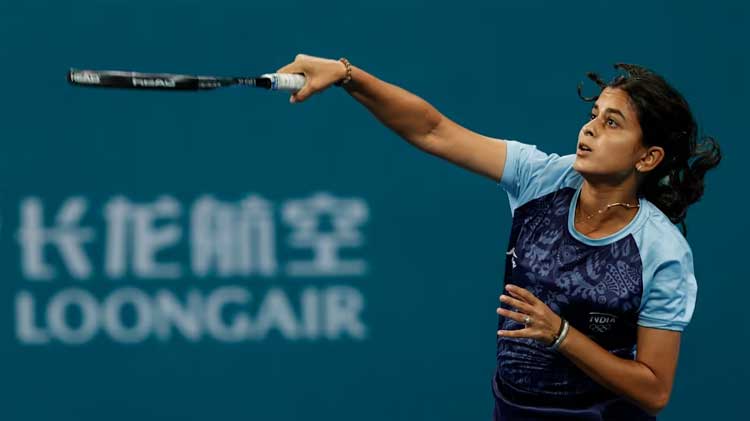
India’s tennis squad for the 2026 Asian Games has been cut from the 12 players proposed by the All India Tennis Association (AITA) to just seven, leaving several of the country’s leading singles contenders out of the team.
The Sports Ministry’s final sanction order, issued on August 22, approved 492 athletes across 35 sports for the Aichi-Nagoya Games, which will be held from September 19 to October 4. However, the ministry did not approve AITA’s full tennis squad.
Only Ankita Raina and Rutuja Bhosale were retained among the women. India’s top-ranked women’s singles player Sahaja Yamalapalli, along with Vaishnavi Adkar, Vaidehee Chaudhari and doubles specialist Prarthana Thombare, were excluded. Men’s singles prospect Manas Dhamne was also left out.
Sahaja ‘Very Shocked’ by Exclusion
Sahaja, ranked 344th in the WTA rankings and India’s No. 1 women’s singles player, said she was shocked and disappointed by the decision.
“I was very much looking forward to competing in the Asian Games,” she told PTI from the Netherlands, where she is competing on the WTA circuit.
Sahaja also questioned the logic of excluding players who may not be seeded but could still challenge higher-ranked opponents.
“There are instances where the underdogs beat the top players and win medals and win tournaments because it is a different set-up,” she said.
Why Did the Government Cut the Squad?
The Sports Ministry’s selection policy for the 2026 Asian Games focuses on medal potential and allows the government to reject recommendations from national sports federations if athletes do not meet prescribed performance benchmarks.
For individual events, recent performances and rankings are among the key criteria, while doubles and team events are assessed separately. The policy also allows exceptions where there are sport-specific reasons to justify the selection of athletes who fall below the benchmark.
AITA interim Secretary General Sunder Iyer said the federation had tried to persuade the authorities to approve all 12 players but was told that the government was applying its criteria of selecting athletes ranked among the top eight in Asia.
“It’s disappointing but the criteria is the same for all sports,” Iyer told PTI.
AITA had argued that tennis should be assessed according to its multiple medal events, including singles, doubles and mixed doubles. The association also pointed to India’s strong mixed-doubles combinations, with three pairs among the top eight accepted entries, while India was eligible to field two pairs.
AITA Seeks Review
The tennis body had specifically backed Sahaja, citing her status as India’s highest-ranked singles player and her performances at ITF and WTA events against higher-ranked opponents.
Vaishnavi was also recommended after her bronze medal at the FISU World University Games, while AITA highlighted Vaidehee’s consistency on the international circuit.
Ankita Raina and Prarthana were selected primarily as doubles specialists. Ankita previously won a women’s doubles bronze at the 2018 Asian Games and reached the quarterfinals in singles and mixed doubles at the 2022 edition.
AITA has urged the Indian Olympic Association to review the exclusions and assess the entries on an event-by-event basis, arguing that the selected players provide India with genuine medal opportunities.
India’s Tennis Medal Prospects Hit
The biggest concern is India’s weakened women’s singles challenge. Although Ankita has been entered in singles, her recent difficulty in reaching main draws on the international circuit could limit India’s medal prospects.
With the Asian Games approaching, there is little time to resolve the dispute. The controversy has also raised questions over whether national federations or the government should have the final say when it comes to identifying medal prospects.
For Sahaja, the answer is to trust the players.
“Have the belief in players because we have the belief in us,” she said, pointing to qualifiers making deep runs at Grand Slam tournaments.
“That’s where the fun is,” she added.
Comments are closed.