
China’s Premier Hails Deepening ASEAN Relations Ahead of Trump’s Visit

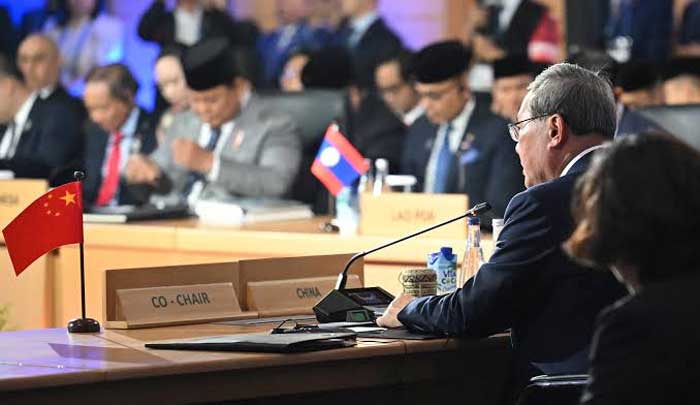
Chinese Premier Li Qiang on Monday praised what he described as “truly extraordinary” economic achievements between China and Southeast Asia, reaffirming Beijing’s commitment to free trade amid growing global trade restrictions and ahead of US President Donald Trump’s arrival in the region.
Speaking at a summit with leaders of the Association of Southeast Asian Nations (ASEAN) in Manila, Li said economic relations between China and the regional bloc had continued to strengthen despite rising unilateralism, protectionism and geopolitical tensions.
“The past five years have been truly extraordinary, and the achievements we scored have not come easily,” Li said, highlighting annual trade between China and the 11-member ASEAN bloc of more than $1 trillion last year and cumulative two-way investment exceeding $500 billion.
“We remain firmly committed to safeguarding multilateralism and promoting free trade and endeavour to make the pie bigger,” he added.
China is ASEAN’s largest trading partner and a major source of investment. However, the bloc’s biggest economies are also seeking to strengthen economic ties with the United States amid uncertainty over trade and diplomatic relations under the Trump administration.
According to state news agency Xinhua, Li said cooperation was increasingly important in a turbulent global environment, urging China and ASEAN to “stand united, ward off interference, and work together.”
Trump’s Manila Visit Expected to Draw Protests
Trump is scheduled to arrive in Manila on Tuesday toward the end of the ASEAN summit before travelling to the Asia-Pacific Economic Cooperation (APEC) forum in Shenzhen. A trilateral meeting involving Chinese President Xi Jinping and Russian President Vladimir Putin is scheduled for Thursday.
His arrival is expected to trigger protests following four days of demonstrations in Manila, including the burning of Trump effigies by leftist groups, students and workers. Protesters are demanding an end to the war in the Middle East and the cancellation of the US-led Pax Silica initiative.
During his visit, Trump will meet ASEAN leaders and attend his first meeting of the Quad, comprising the United States, Japan, Australia and India. It will be the group’s first gathering in two years.
Former US President Joe Biden regarded the Quad as a major foreign policy achievement and emphasised its importance during his six meetings with the group.
The grouping is widely viewed as an effort to balance China’s growing influence in the Indo-Pacific, although its members have repeatedly said it is not directed against any particular country.
UN Offers Support for Possible Denuclearization Talks
ASEAN leaders also held discussions on Monday with representatives from Australia, South Korea and the United Nations.
UN Secretary-General Antonio Guterres reiterated calls for a ceasefire in Ukraine and improved humanitarian access in conflict-hit Myanmar.
Addressing the planned trilateral discussions between the United States, Russia and China in Shenzhen, Guterres said the United Nations was prepared to fully engage with any initiative aimed at denuclearization.
Trump has previously expressed confidence that a denuclearization agreement involving Russia and China could be possible. China’s Foreign Ministry said on Monday that the planned talks would help “promote world peace and stability.”
“This is what we would like to see,” Guterres said, while cautioning that an agreement was not guaranteed.
Meanwhile, South Korean President Lee Jae Myung proposed new cooperation initiatives with ASEAN in artificial intelligence and creative industries, saying negotiations to expand their free trade agreement were progressing.
“We must respond proactively to the changing global trade environment and move forward together toward an era of $300 billion in annual trade,” Lee said.
ASEAN Summit Ends Without South China Sea Agreement
The ASEAN summit concluded on Sunday without a breakthrough on a long-awaited code of conduct with Beijing aimed at managing territorial disputes in the South China Sea. The Philippines, which chairs the bloc, had hoped the agreement could be finalised this year.
ASEAN also agreed to maintain its policy of excluding Myanmar’s military leaders from high-level summits, while leaving open the possibility of their return if “sustained and concrete progress” is made on the bloc’s long-standing peace plan.
The meeting also saw Indonesian President Prabowo Subianto apologise to neighbouring Singapore and Malaysia over the effects of prolonged transboundary haze caused by months of wildfires.
Comments are closed.