
Delhi Kanwar Yatra noise crosses 95 dB in homes, residents complain of sleepless nights

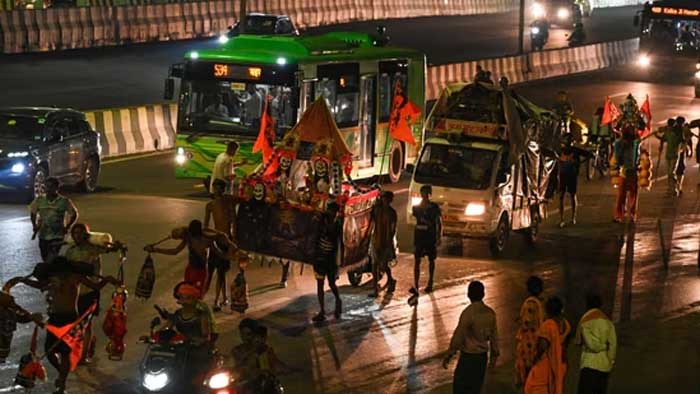
While the annual Kanwar Yatra has disrupted traffic across Delhi, residents living near temporary camps for kanwariyas in west Delhi’s Ramesh Nagar say they are facing days of blaring music, sleepless nights, blocked roads and mounting garbage.
Hindustan Times conducted sound-level measurements in B-Block, Ramesh Nagar, and found noise levels inside homes closest to two Kanwar camps near the Ramesh Nagar Metro station crossing 90 decibels.
At one residence, readings reached 90.6 decibels at 6.30pm, 91.4 dB at 7.30pm and 95 dB at 8.30pm. Even at a home around 200 metres away, readings ranged from 67.2 to 76.3 dB during the afternoon and remained between 65 and 75 dB from 6pm to 11pm.
Noise levels recorded at the camp itself were even higher, reaching 101.3 dB at one point.
The World Health Organization recommends limiting exposure at such levels because prolonged exposure can increase the risk of hearing damage. Under Central Pollution Control Board norms, ambient noise limits for residential areas are 55 dB during the day and 45 dB at night.
‘I haven’t slept properly in three days’
Residents said the continuous music and announcements from loudspeakers were disrupting sleep, work and school routines, with some complaining that the heavy bass caused their walls and windows to vibrate.
Gurbir Singh, 55, a stockbroker living opposite a camp, said he had barely slept for three days and that his elderly mother was experiencing palpitations. Noise readings inside his home reached 90.1 dB at 6.30pm and 91.5 dB at 7.30pm.
“I can’t sleep or work peacefully. The boombox is blaring all the time,” he said.
Shekhar Bhatia, 39, an MNC employee, said the noise had disrupted office calls and prevented his elderly parents from sleeping peacefully.
For residents working from home, the disruption has made it difficult to attend calls. Ana Gogia, 38, a chartered accountant working in Gurugram, said traffic congestion had also made it harder to reach schools, offices, gyms and doctors.
Traffic, garbage add to residents’ woes
Residents said congestion worsened during school hours as roads were blocked or diverted because of the movement of kanwariyas. Some parents reportedly chose to collect their children themselves rather than rely on school buses navigating crowded roads.
Komal Mutreja, 45, a homemaker, said the combination of loud music, traffic and poor sanitation had affected her children’s studies.
Residents also complained about garbage accumulating around the camps, including discarded water bottles and snack packets.
Safety was another concern for some residents. Advocate Puneet Mahendru, 35, said groups of kanwariyas carrying wooden sticks and bats sometimes walked in the middle of roads and entered residential streets.
Residents said they had contacted local police over noise and traffic problems in previous years, but alleged that any reduction in volume was temporary.
Some residents stressed that their concerns were not directed at the religious practice itself but at the disruption caused by loud music, congestion and the use of residential streets.
“This is what we are teaching our children? That they can use the streets as their home?” Gogia said.
Comments are closed.