
Election earthquake: TVK jolts Tamil Nadu, UDF returns in Kerala, BJP scripts Bengal breakthrough

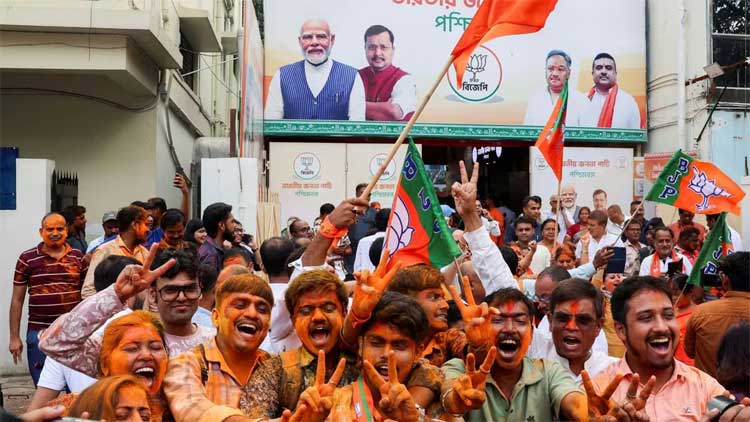
May 4 delivered one of the most dramatic election verdicts in recent Indian political history — with actor-turned-politician Vijay’s TVK shaking up Tamil Nadu, the Congress-led UDF scripting a comeback in Kerala, and the BJP securing a landmark victory in West Bengal. While some parties celebrated historic breakthroughs, others suffered crushing setbacks.
Though TVK fell short of an outright majority in its electoral debut, its performance was enough to fundamentally alter Tamil Nadu’s political landscape. In Assam and Puducherry, meanwhile, incumbent NDA governments retained power comfortably.
Here’s what shaped the verdict across key states:
Tamil Nadu: Vijay breaks the Dravidian duopoly
Tamil Nadu has not seen an electoral debut this disruptive since 1977, when MG Ramachandran swept to power and redrew the state’s politics.
Nearly five decades later, actor Joseph Vijay Chandrasekhar has delivered a similarly transformative result. His party, Tamilaga Vettri Kazhagam (TVK), emerged as the surprise force of the election, coming within striking distance of power and breaking the half-century dominance of the DMK-AIADMK axis.
In doing so, Vijay achieved what Vijayakanth could not, what Rajinikanth never attempted, and what Kamal Haasan failed to pull off.
His success rested on three pillars:
1. Rebooting Dravidian politics, not rejecting it
Vijay positioned TVK as an alternative to the established Dravidian majors without abandoning core Dravidian ideals. He invoked Periyar, CN Annadurai, and MGR, emphasised social justice, Tamil identity, and welfare politics, while carefully avoiding overt communal positioning.
His manifesto — offering ₹2,500 monthly for women, ₹10,000 for unemployed graduates, free gas cylinders, crop loan waivers, and marriage assistance — echoed the welfare-heavy model that has defined Tamil Nadu politics for decades.
2. Outsider appeal
At a time when Tamil Nadu lacks towering political figures like J Jayalalithaa or M Karunanidhi, Vijay’s image as a wealthy, successful outsider entering politics resonated deeply.
Many voters saw him as someone with nothing left to gain personally — and therefore less susceptible to corruption.
3. Film club machinery
TVK’s organisational strength came from Vijay’s sprawling network of fan clubs, which he converted into an election machine.
Many candidates were first-time contestants with no corruption baggage, reinforcing TVK’s freshness.
The verdict is also a damning indictment of both Dravidian giants. The DMK struggled with allegations of local-level corruption and dynastic politics, while the AIADMK failed to build ideological coherence or a broad coalition.
Tamil Nadu’s message was unmistakable: voters wanted disruption.
Assam: Himanta Biswa Sarma cements dominance
Assam’s election was widely viewed as a referendum on Chief Minister Himanta Biswa Sarma.
The result was emphatic.
The NDA crossed the 100-seat mark for the first time in Assam’s history, while the BJP secured a simple majority on its own — a milestone in the state.
Sarma’s campaign leaned heavily on:
- Welfare schemes such as Orunodoi
- Infrastructure development
- Protection of indigenous Assamese identity
- Tough rhetoric on infiltration and undocumented migration
The Congress, led by Gaurav Gogoi, hoped anti-incumbency and alliance arithmetic would deliver a breakthrough.
Instead, it faltered badly.
Despite some traction in Upper Assam and pockets of Lower Assam, the opposition failed to present a compelling statewide alternative.
The result further elevates Sarma’s national stature within the BJP and establishes Assam as one of the party’s strongest eastern bastions.
Kerala: UDF returns as Left collapses
Kerala delivered a political reversal few anticipated in this magnitude.
The Congress-led United Democratic Front (UDF) swept back to power, while the Left Democratic Front (LDF) suffered its worst-ever performance.
Several factors contributed to the collapse of the Pinarayi Vijayan-led government:
- Strong anti-incumbency after a decade in office
- Corruption allegations, including the Karuvannur cooperative bank scandal
- Internal discontent
- Perceived over-centralisation around Vijayan’s leadership
Thirteen ministers lost their seats.
The UDF capitalised through disciplined candidate selection, tighter coalition management, and aggressive campaigning around welfare promises, including:
- Free bus travel for women
- ₹1,000 monthly for female college students
- ₹3,000 pensions
- ₹25 lakh health insurance
The BJP also registered its strongest-ever assembly performance in Kerala, winning three seats and expanding its footprint.
For the first time in nearly six decades, the Left is now out of power in every Indian state.
West Bengal: BJP’s saffron breakthrough
The BJP’s victory in West Bengal ranks among its most consequential state wins since Uttar Pradesh in 2017.
Its triumph rested on three major shifts:
1. Hindu consolidation and Muslim fragmentation
The BJP successfully consolidated a large section of Hindu voters across caste lines while benefiting from fragmented opposition support among Muslim voters.
Seats like Tehatta reflected this shift sharply.
2. Backlash against TMC’s local power structure
Resentment against alleged extortion, local strongmen, and “cut-money” politics damaged the Trinamool Congress deeply, even in urban bastions like Jadavpur.
3. Welfare fatigue among women voters
Mamata Banerjee’s welfare-driven women’s coalition, which proved decisive in 2021, showed signs of erosion.
For many voters, welfare benefits were no longer enough without employment generation and economic opportunity.
The BJP also benefited from an expanded ground operation and heightened voter confidence in its organisational reach.
For Mamata Banerjee, the verdict marks the end of a political script that had repeatedly helped her overcome anti-incumbency.
This time, it failed.
The bigger picture
These results reflect a broader shift in Indian politics:
- Charismatic disruption works when established systems stagnate (Tamil Nadu)
- Strong incumbency can prevail if paired with narrative control and organisational depth (Assam)
- Anti-incumbency remains potent when governance fatigue sets in (Kerala)
- Welfare politics alone has limits when voters seek jobs and structural change (West Bengal)
May 4 may well be remembered as a turning point — not just for the states involved, but for the future direction of Indian politics.
Comments are closed.