
European, Canadian leaders gather in Yerevan as Trump casts shadow over summit

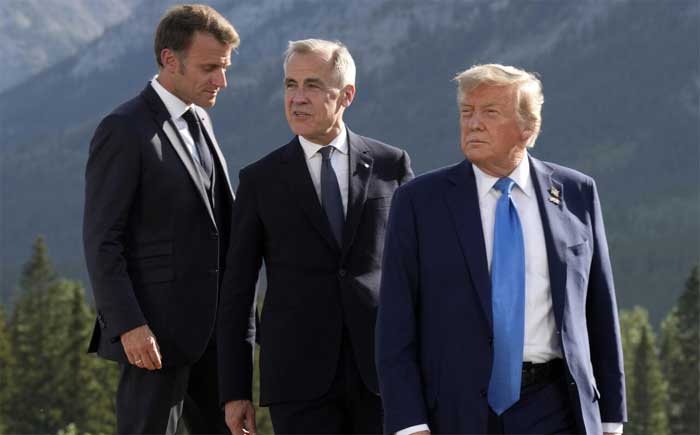
European leaders and Canadian Prime Minister Mark Carney are gathering in Armenia on Monday for a high-stakes summit aimed at navigating mounting geopolitical uncertainty shaped by an increasingly unpredictable White House.
US President Donald Trump is expected to cast a long shadow over the meeting of the European Political Community (EPC) in Yerevan, where leaders will focus on two pressing crises: Russia’s war in Ukraine and escalating instability in the Middle East.
“Leaders from across the continent, with Canada as a guest, will discuss how to cooperate to strengthen security and collective resilience,” European Council President Antonio Costa said as he arrived in the Armenian capital on Sunday.
The summit comes amid fresh tensions in transatlantic relations, sharpened by the war with Iran that has rattled global markets and driven up energy prices.
The divide widened after a public clash between Trump and German Chancellor Friedrich Merz, who criticized Washington’s handling of the conflict. In response, the United States announced plans to withdraw 5,000 troops from Germany — a move that has intensified concerns over America’s long-term commitment to European security.
The announcement comes as Russian President Vladimir Putin’s war in Ukraine enters its fifth year.
Ukrainian President Volodymyr Zelensky and NATO Secretary General Mark Rutte are attending the summit, while French President Emmanuel Macron will represent Merz.
Canada’s Carney, attending as the first non-European guest in EPC history, underscores Ottawa’s growing alignment with Europe as both seek to counterbalance Trump’s economic and foreign policy shifts.
A senior EU official described the summit as an opportunity to underscore that “Europe’s security is a 360-degree challenge.”
Canada’s growing European tilt
Like Europe, Canada has felt the economic impact of Trump’s tariffs, but Carney has emerged as a leading voice among middle powers seeking greater strategic independence.
Earlier this year, he called for deeper cooperation among medium-sized nations facing what he described as a world increasingly shaped by great-power rivalry and a weakening rules-based order.
“The EPC was initially perceived as an anti-Putin club,” said Sebastien Maillard of the Jacques Delors Institute.
“With the invitation to Canada, this initiative — originally defined by geography — is now taking on an anti-Trump slant.”
As part of its strategic shift, Ottawa recently joined the EU’s defense financing scheme, becoming the first non-European nation to do so, while also expanding trade cooperation with the bloc.
“Canada has a way of looking at the world and looking at ways to solve the challenges we have currently that Europe shares to a great extent,” an EU official said.
Armenia’s delicate balancing act
The biannual EPC forum was launched by Macron in 2022 following Russia’s invasion of Ukraine.
It brings together EU member states and 21 non-EU countries, from Britain to Albania, primarily as a platform for strategic dialogue rather than formal decision-making.
Most leaders arrived Sunday evening for an informal dinner ahead of Monday’s discussions.
Spanish Prime Minister Pedro Sanchez is expected to join after his plane was forced to make an emergency landing in Turkiye due to technical problems, requiring an overnight stop in Ankara.
This marks the first EPC summit held in the Caucasus, highlighting Armenia’s growing engagement with Europe as it cautiously distances itself from longtime ally Russia.
The gathering will be followed Tuesday by an EU-Armenia summit involving Costa and European Commission President Ursula von der Leyen, who described it as “a major milestone” in Yerevan’s deepening ties with Brussels.
Relations between Armenia and Moscow have deteriorated in recent years, particularly after Russian peacekeepers failed to intervene during clashes with neighboring Azerbaijan.
Prime Minister Nikol Pashinyan has since pursued what he calls a strategy of “diversification” — expanding ties with both Russia and the West.
Armenia signed a comprehensive partnership agreement with the EU in 2017 and formally signaled last year its intention to seek membership.
In April, the EU launched a mission to help Armenia combat foreign interference, amid suspicions of Russian-backed disinformation efforts ahead of June elections.
Russian President Vladimir Putin has said he remains “completely calm” about Armenia’s European outreach, while warning that membership in both the EU and the Russian-led Eurasian Economic Union would be “simply impossible.”
Comments are closed.