
France Announces Curfews As Authorities Struggle To Contain Violent Protests

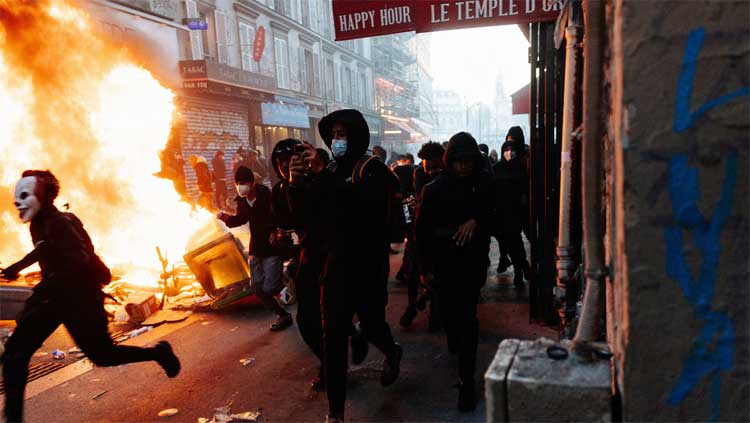
France announced partial curfews in Paris and several other cities on Monday after demonstrations over soaring living costs escalated into some of the worst street violence the country has witnessed in recent years.
Prime Minister Sebastien Lecornu did not rule out declaring a state of emergency after Interior Minister Laurent Nunez said police had “lost control” during the unrest. The government has pledged to restore order amid mounting criticism over its handling of the demonstrations.
The disruption continued on Monday, when the Louvre Museum in Paris closed after a small group of student protesters blocked its entrance. The US Embassy in Paris also urged American citizens to avoid the demonstrations.
The unrest comes just six months before France votes to elect a successor to President Emmanuel Macron. Protest organisers have called for another round of demonstrations next Saturday, raising concerns that the violence could continue.
Authorities announced partial curfews from Monday evening until Tuesday morning in several cities, including Paris, Lille and Lyon, to protect businesses and prevent further damage. In Paris, demonstrations were banned from 8 pm, while the curfew began at 11 pm local time.
“I’m absolutely determined to restore public order,” Lecornu said.
Protests Over Cost Of Living Escalate Into Violence
Around half a million people took to the streets across France on Saturday to protest the rising cost of living, marking the culmination of four weeks of demonstrations that initially began with students demanding better conditions at high schools.
What began as largely peaceful protests descended into violence in several cities. Masked groups attacked law enforcement personnel, broke into public buildings and set some ablaze, looted shops, and torched cars, bicycles and scooters.
The government faced accusations that it had failed to anticipate the scale of the unrest and respond effectively. Macron acknowledged shortcomings in the response, despite the deployment of 60,000 law enforcement personnel on Saturday.
More than 2,500 people were arrested, while nearly 1,000 security personnel were injured. Protesters also suffered injuries, including one demonstrator whose hand was reportedly blown off by a police crowd-control grenade.
Justice Minister Gerald Darmanin said more than 2,513 people had been taken into police custody nationwide since the weekend. He added that 67 people had been jailed and “dozens” of criminal cases had been opened.
Darmanin also said authorities would use facial recognition technology on social media to identify those suspected of participating in the violence.
At least 3,000 shops were damaged, with the financial losses estimated to run into hundreds of millions of euros.
In a televised address on Sunday, Macron condemned what he described as “unbridled” violence.
France Targets Online Listings For Looted Goods
France’s digital minister, Anne Le Henanff, on Monday urged online resale platforms to remove listings for allegedly stolen goods following widespread looting during the weekend protests.
She summoned representatives of companies including Vinted and eBay to discuss measures to prevent stolen items from being sold online.
Meanwhile, Nunez offered his resignation after the weekend’s violence, but Macron refused to accept it.
The interior minister and intelligence officials were scheduled to meet late Monday to discuss the unrest and the government’s response.
Louvre Closes After Student Protest
Tourists visiting Paris encountered further disruption on Monday when a group of around a dozen demonstrators blocked the entrance to the Louvre, the world’s most visited museum.
The museum was closed as protesters gathered near its iconic glass pyramid entrance, leaving visitors uncertain about when they could enter.
“We don’t want to get involved. We want to stand back and get away from them,” Pat Boland, a 73-year-old tourist from Australia, told AFP outside the barricades.
The US Embassy urged American citizens to steer clear of the demonstrations, while several governments issued warnings about potential security risks.
The European Union condemned the violence as “unacceptable” but stressed that the right to peaceful protest must be protected.
Germany also condemned the unrest and updated its travel advice for France, warning that further outbreaks of violence in the coming days could not be ruled out. China, meanwhile, advised its citizens travelling to France to remain alert and take appropriate safety precautions, state broadcaster CCTV reported.
Political Tensions Rise Ahead Of Presidential Election
The unrest has intensified political tensions ahead of France’s presidential election, scheduled for April and May, which will determine Macron’s successor after a decade of centrist leadership.
Far-right presidential candidate Marine Le Pen has been performing strongly in opinion polls, while the government has accused ultra-left groups of encouraging violence to improve the electoral prospects of far-left leader Jean-Luc Melenchon.
The competing political accusations have added to concerns that the demonstrations could influence the election campaign and deepen divisions within French society.
Cost-Of-Living Protests Spread Across Europe
France is not the only European country witnessing public anger over rising living costs, with demonstrations and clashes reported elsewhere over the weekend.
In Milan, Italy, clashes broke out on the sidelines of a cost-of-living demonstration. Mayor Giuseppe Sala said he was deeply concerned about the developments.
“I’m very worried because it’s a new phenomenon, which also originates from an international scenario and therefore feeds itself,” Sala said.
In Belgium, police deployed tear gas and water cannon to disperse protesters in Brussels and Liege.
Meanwhile, demonstrations over soaring housing costs have continued in Spain and Portugal. Protesters have established tent encampments in central Madrid, with similar camps appearing in Lisbon and Porto.
The unrest across Europe highlights mounting public frustration over living expenses, housing affordability and economic pressures, even as French authorities race to contain the violence and restore public order.
Comments are closed.