
From Chathan Master to Ayyankali: BJP Seeks to Appropriate Kerala’s Dalit Legacy

The Bharatiya Janata Party (BJP) is stepping up its efforts to connect with Kerala’s Dalit community by invoking the legacy of prominent social reformers and leaders who were historically associated with rival political parties, including the Congress and the Left.
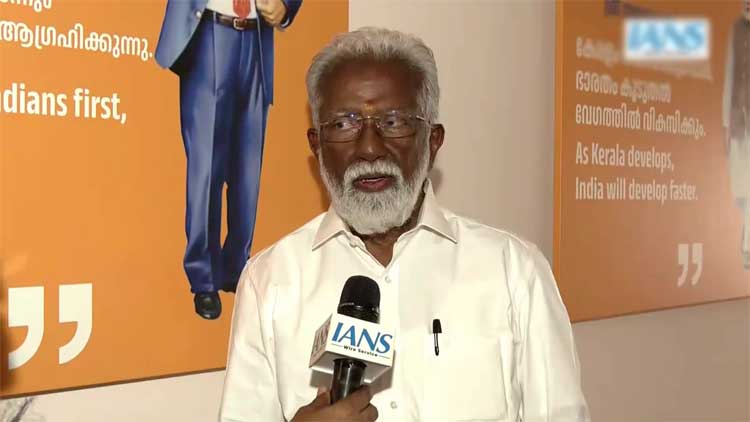
The strategy came into focus on November 19 when former Mizoram Governor and BJP national executive committee member Kummanam Rajasekharan criticised the Communist Party of India (CPI) for allegedly neglecting the legacy of P K Chathan Master, a prominent Dalit leader, social reformer and Kerala’s first Dalit minister.
Speaking at a memorial event in Irinjalakuda, Thrissur district, organised to commemorate Chathan Master, Rajasekharan expressed disappointment over the condition of his memorial.
“It’s really painful that the memorial monument of Chathan master, who had dedicated his life for the upliftment of the SC community, is remaining neglected,” he said.
He accused the CPI of failing to honour a leader who had devoted his life to the party and the welfare of marginalised communities. Rajasekharan pointed out that when the CPI constructed an office in Chathan Master’s hometown, it named the building after former Chief Minister C Achutha Menon rather than the Dalit leader.
His remarks highlighted the BJP’s broader political strategy of reaching out to Kerala’s Dalit population, which accounts for around 9.1 per cent of the state’s population, by invoking the contributions of influential community leaders and reformers.
The party is seeking to position itself as a political inheritor of the struggles of several Dalit icons, including Ayyankali, Kavarikulam Kandan Kumaran and Dakshayani Velayudhan.
The outreach is also being supported by three former Left leaders: former CPI(M) legislator S Rajendran, former two-term CPI MLA K Ajith and former Nattika CPI legislator C C Mukundan.
BJP Seeks to Reclaim Legacy of Dalit Reformers
P K Chathan Master was a CPI leader and a member of Kerala’s first government, led by E M S Namboodiripad in 1957. A prominent social reformer, he was among the founders of the Kerala Pulaya Maha Sabha (KPMS), an organisation representing the Scheduled Caste community.
At the November 19 event, Rajasekharan argued that Dalit leaders and reformers had not received adequate recognition from either the Congress or the Left in Kerala.
He also questioned whether land reforms in the state had significantly improved the living conditions of Dalit communities, particularly plantation workers.
“The oppressed section should be imparted with self-respect and self-confidence,” he said, adding that plantation workers continued to live in severe poverty and difficult conditions.
Rajasekharan said the BJP had decided to fight for Dalit rights and argued that the next phase of social reform in Kerala should focus on improving the social and economic position of marginalised communities.
Ayyankali, Kavarikulam Kandan Kumaran and Dakshayani Velayudhan are among Kerala’s pioneering Dalit reformers who challenged caste discrimination and campaigned for equality, education and social justice.
Ayyankali, born into the oppressed Pulayar community in the princely state of Travancore, emerged as a revolutionary social reformer who challenged caste restrictions through direct action.
Kavarikulam Kandan Kumaran founded the Brahma Pratyaksha Sadhu Jana Paripalana Sangham in 1912 to organise the Paraya community and fight social discrimination.
Dakshayani Velayudhan was India’s first Dalit woman graduate and the only Dalit woman member of the Constituent Assembly.
Rajasekharan argued that all three reformers deserved greater recognition. He pointed out that Ayyankali was yet to receive a memorial in his native village of Venganoor in Thiruvananthapuram district, while Velayudhan’s contributions to women’s empowerment had not received adequate recognition in Kerala.
He said the BJP wanted to carry forward their legacy of social justice, dignity and empowerment of oppressed communities. The party had also organised a meeting to formulate a plan for reclaiming the contributions of these reformers through a year-long programme.
Former Left Leaders Become Key to BJP’s Dalit Outreach
The BJP is also relying on former Left leaders to strengthen its outreach among Dalit voters in Kerala.
S Rajendran, a former three-time CPI(M) MLA from the Devikulam constituency in Idukki district, was once among the party’s most prominent leaders representing plantation workers in the state’s high-range regions.
He was suspended from the CPI(M) in 2022 over allegations of internal sabotage during the 2021 Assembly elections. He subsequently joined the BJP in January this year, ahead of the Assembly polls.
K Ajith, a former two-term MLA from Vaikom, left the CPI in March after spending four decades with the party. He alleged that the Left had failed to address the concerns and problems of the Dalit community.
Similarly, C C Mukundan, a former CPI legislator from Nattika in Thrissur, quit the party shortly before the recent Assembly elections after being denied a ticket.
The BJP hopes that the association of these leaders with the party will help it strengthen its presence among Dalit communities and challenge the traditional political dominance of the Congress and Left in the state.
BJP’s Borrowed Legacy Strategy Draws Left Criticism
The BJP’s attempt to claim the legacy of leaders associated with rival political movements is not new.
In 2025, the party adopted a similar approach towards two veteran Congress figures: V R Krishnan Ezhuthachan in Thrissur and Chettur Sankaran Nair in Palakkad.
Ezhuthachan was associated with India’s freedom struggle and was a Gandhian, journalist and trade unionist. Nair was a prominent lawyer, judge and former president of the Indian National Congress.
The BJP commemorated Ezhuthachan on his 21st death anniversary after his memorial was renovated using the local development fund of Union Minister of State Suresh Gopi, who was then a Rajya Sabha member.
The party has also been observing Nair’s death anniversary since 2024. BJP leaders have said that a request to establish a memorial for him in Palakkad is pending with the Union government.
However, the BJP’s latest Dalit outreach has drawn sharp criticism from the Left.
Senior CPI leader and former minister V S Sunil Kumar rejected the party’s attempt to claim Chathan Master’s political legacy, arguing that the BJP had no right to associate itself with a leader who had fought against the ideology of the Sangh Parivar.
“Chathan master had been a CPI leader who had fought against the Brahminical politics of Sangh Parivar,” Sunil Kumar said.
He added that Chathan Master had established KPMS following a directive from the CPI and had opposed Hindutva politics throughout his political career.
The CPI leader also vowed that his party would resist the BJP’s efforts to claim the legacy of the late leader.
The political debate reflects the growing importance of Dalit outreach in Kerala, where the BJP is attempting to expand its social base by invoking the contributions of historical reformers and attracting leaders who have broken away from the Congress and Left.
Comments are closed.