
India at COP31: Water-Sharing Agreements Must Reflect Bilateral Ties, Says Bhupender Yadav

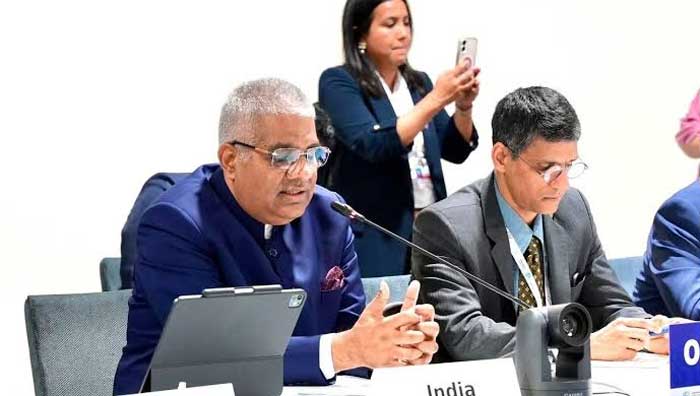
In a clear reference to India’s decision to put in abeyance the Indus Waters Treaty with Pakistan, Environment Minister Bhupender Yadav Wednesday said sharing of waters of transboundary rivers cannot be based on “archaic mechanisms” nor “divorced” from the realities of the overall relationship between two countries.
Delivering India’s national statement at the COP31 climate meeting in the Turkish city of Antalya, Yadav said, “Constructive cooperation and trans-boundary water flows can provide shared progress and prosperity. However, climatic and demographic changes as well as technological advancements are important elements that cannot be ignored.”
“Contemporary cooperation can neither be based on archaic mechanisms nor be divorced from the broader environment in which countries engage with one another,” he said, without making any mention of the Indus Waters Treaty.
His remarks came in response to Pakistan Prime Minister Shehbaz Sharif, who had raised the issue of transboundary water sharing during his address at the climate conference, also without explicitly referring to the treaty.
“Water must never be weaponised. No nation should be allowed to put the lives and livelihoods of people downstream at risk. Water sharing agreements must be honoured in letter and spirit,” Sharif said.
The exchange marked the first time India had publicly articulated its position on the Indus water-sharing issue at an international climate conference.
The 1960 Indus Waters Treaty, brokered by the World Bank, governs the sharing of six rivers of the Indus basin between India and Pakistan. Under its provisions, the eastern rivers — Ravi, Beas and Sutlej — were allocated primarily to India, while Pakistan received rights over the western rivers — Indus, Jhelum and Chenab — subject to certain permitted uses by India.
India announced its decision to place the treaty in abeyance in April 2025, following the terrorist attack in Pahalgam in Jammu and Kashmir that killed 26 people. New Delhi said the treaty would remain suspended until Pakistan credibly and irrevocably ended its support for cross-border terrorism.
Since then, Pakistan has repeatedly raised concerns over India’s position at international forums, arguing that the treaty must be honoured and accusing New Delhi of attempting to use water as a political instrument.
India, however, has maintained that changing circumstances, including population growth, increasing water requirements, technological advancements and the effects of climate change, necessitate a fresh approach to transboundary water cooperation.
New Delhi has also indicated its willingness to renegotiate the treaty, although Pakistan has not responded positively to the proposal.
India’s position has also been reinforced by Prime Minister Narendra Modi’s assertion that blood and water cannot flow together, linking cooperation on water resources to the broader state of bilateral relations.
Yadav’s comments at COP31 came just days before Pakistan’s Climate Change and Environmental Coordination Minister Musadik Masood Malik is scheduled to visit New Delhi to attend the Shanghai Cooperation Organisation’s Civilisational Dialogue Forum.
Malik has previously made strong statements on the water dispute, including threatening action against anyone attempting to control Pakistan’s water supplies. He has, however, maintained that his upcoming visit to India is intended solely for participation in the SCO event and does not involve a bilateral agenda.
Meanwhile, Yadav’s address at COP31 also focused on climate justice, financial obligations of developed countries and the development priorities of nations in the Global South.
He argued that developing countries should not be expected to compromise their economic growth and the living standards of their populations in the name of greater climate ambitions, particularly when developed nations bear a larger historical responsibility for greenhouse gas emissions.
“Our planet is warmer today because industrialisation and economic growth of some was fuelled by unbridled greenhouse gas emissions over two centuries. To now expect the Global South to bear the burden of addressing the consequences of their past actions in the name of higher ambition is unjustified,” he said.
Yadav stressed that developing countries could not be asked to choose between climate action and their legitimate right to development, decent living standards, healthcare and education.
“Equitable access to the remaining depleted carbon budget is non-negotiable,” he said, calling on developed nations to fulfil their climate finance commitments honestly and expeditiously.
He also highlighted India’s ambition to become a developed nation by 2047, saying the country’s economic growth would generate benefits beyond its borders, particularly for other developing nations.
“India’s growth is a rising tide and that can also lift other developing countries,” he said.
The minister emphasised that climate negotiations must be guided by equity and the principle of Common but Differentiated Responsibilities and Respective Capabilities (CBDR-RC), which recognises that countries have different capacities and historical responsibilities in addressing climate change.
India also called for climate commitments to translate into tangible action, adequate financial resources, technology transfer and support for developing countries.
The COP31 meeting in Antalya has brought together governments to discuss climate finance, emissions reduction, adaptation and the implementation of the Paris Agreement.
Yadav’s remarks on transboundary water sharing added a significant diplomatic dimension to India’s participation, placing the Indus dispute within the broader debate over climate change, resource management and international cooperation.
Comments are closed.