
India-UK FTA to make economic growth ‘inevitable’, says UKIBC chief

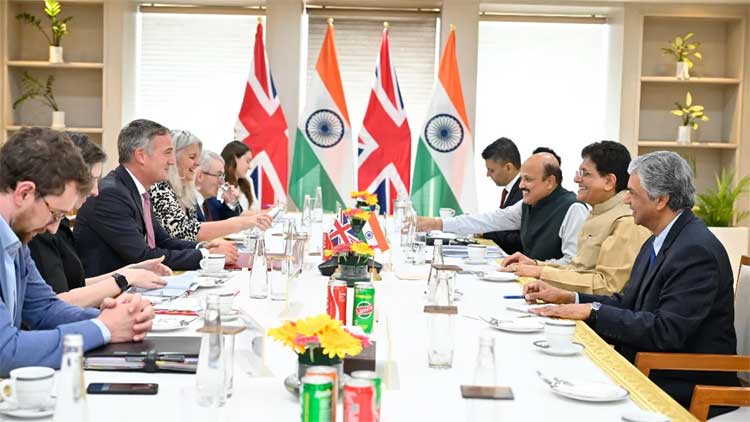
There is already a sense of “euphoria” across industries over the opportunities created by the India-UK free trade agreement, and the pact’s implementation this month is expected to drive sustained economic growth in both countries, according to UK India Business Council (UKIBC) Group CEO Kishore Jayaraman.
The UK-India Comprehensive Economic and Trade Agreement (CETA), signed in 2025, is set to come into force on July 15.
Jayaraman said he remains “very bullish” about the future of the India-UK partnership, describing the agreement as a transformative step that will deepen trade, investment and business collaboration.
“India offers capacity and capability, so scalability for businesses that want to scale up in the Indian market just gets that much easier,” Jayaraman told PTI in an interview.
He said the agreement presents significant opportunities for small and medium enterprises (SMEs), startups and creative industries to expand operations and tap into India’s growing market.
“I think this is a celebration for SMEs, startups and creative people to scale themselves through the capacities and capabilities that India offers and go to the next level of their businesses,” he said.
“They should be stepping up, understanding what it means, developing a business plan that includes India in their roadmap, and eventually grow, because growth is but inevitable through this agreement.”
Official estimates show bilateral trade between India and the UK reached £47.9 billion in the four quarters ending in 2025, marking a 10% increase over previous years. Analysts project the CETA could double trade between the two countries by 2030.
According to Jayaraman, businesses across sectors are already looking ahead to the benefits of the agreement.
“I think there is already euphoria in the industry of all the possibilities that exist… about the kind of expansion different sectors will witness, from food and beverage, education, digital technologies to energy and infrastructure. There’s a lot of opportunity here for this agreement to enhance trade between the two nations,” he said.
While acknowledging that implementation could face challenges, Jayaraman said the agreement reflects a long-term strategic commitment by both governments.
“How we get through those obstacles will come from a strategic intent. That’s what the CETA is about—a strategic intent for both nations to say we can be partners, allow scalability across multiple sectors, and make sure there is market access and appropriate tariffs,” he said.
Among the sectors expected to gain the most, he highlighted advanced manufacturing and engineering, energy and infrastructure, financial services, digital technologies and artificial intelligence, healthcare and life sciences, while also pointing to education, food and beverage, and startups as key beneficiaries.
Jayaraman, who recently joined Commerce and Industry Minister Piyush Goyal in London to launch the CETA Manual: A Business Utilisation Guide, said the next priority is helping businesses convert the agreement into practical commercial opportunities.
“The India-UK corridor has been working very well, but when you really want to take it to the next curve, there’s got to be meaningful change. I think the CETA is that change,” he said.
He also underscored the significance of the Double Contribution Convention, which comes into effect alongside the trade pact and exempts temporary cross-border workers from paying social security contributions in both countries.
Calling it a “win-win” arrangement, Jayaraman said the convention would improve employee mobility, productivity and efficiency while making overseas assignments more attractive.
“It allows the employee to feel that much better and to celebrate their experience in the United Kingdom and vice versa. The takeaway from that will be greater productivity, greater efficiency, greater motivation and greater mobility,” he said.
The India-UK CETA was signed during Prime Minister Narendra Modi’s visit to Britain in July 2025. After completing the UK’s parliamentary ratification process, Modi and British Prime Minister Keir Starmer agreed on July 15, 2026, as the date for the agreement’s entry into force, marking a major milestone for negotiations that began in January 2022.
Describing the pact as more than just a trade agreement, Jayaraman said it formalises a long-standing partnership between the two countries.
“It is a relationship that’s there for a lifetime and what this bilateral agreement does is formalise that, so the industry understands that both nations are very serious about how we trade with each other,” he said.
“I think, in marriage parlance, it is like a renewing of vows,” he added.
Comments are closed.