
India’s Long-Range Land Attack Cruise Missile Clears Crucial Flight Test

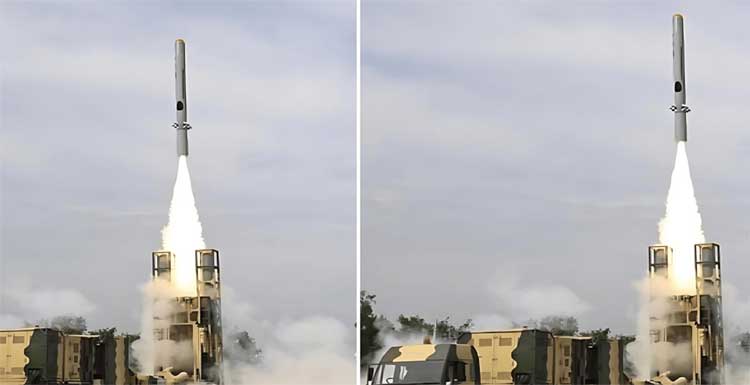
After years of development challenges and setbacks linked to the Nirbhay cruise missile programme, India achieved a significant milestone on June 15 with the successful flight test of the indigenously developed Long Range Land Attack Cruise Missile (LRLACM), often described as India’s answer to the US Tomahawk cruise missile. The Defence Research and Development Organisation (DRDO) announced that all mission objectives were successfully met during the test conducted from Dr APJ Abdul Kalam Island off the Odisha coast.
The LRLACM represents the next stage in India’s long-range cruise missile capability and is understood to have evolved from technologies developed under the Nirbhay programme. Designed for precision strikes against high-value land targets, the missile significantly enhances India’s stand-off attack capabilities and long-range conventional deterrence.
According to official statements, the missile is fully indigenous, with its subsystems developed by multiple DRDO laboratories in collaboration with Indian industry partners. The Aeronautical Development Establishment (ADE) in Bengaluru serves as the nodal laboratory for the project. The test was witnessed by representatives from the Indian Air Force and the Indian Navy, highlighting its potential multi-service role.
Defence experts view the LRLACM as a critical addition to India’s growing arsenal of precision-strike weapons. Cruise missiles flying at low altitudes are difficult for enemy radar systems to detect and intercept, making them valuable assets in modern warfare. Reports indicate the missile is intended to provide long-range precision strike capability and can engage targets at distances exceeding 1,000 kilometres, with some assessments placing its potential range between 1,000 and 1,500 kilometres.
The successful test comes at a time when long-range stand-off weapons are increasingly shaping battlefield strategies worldwide. Both China and Pakistan possess operational cruise missile capabilities, making the development of indigenous long-range systems a strategic necessity for India.
Defence Minister Rajnath Singh hailed the successful trial as a major achievement for India’s indigenous defence ecosystem, while DRDO officials said the missile validated critical technologies and demonstrated the country’s growing expertise in long-range precision-strike systems.
The LRLACM programme is expected to undergo further developmental and user trials before eventual induction into the armed forces. Once operational, the missile is likely to become an important component of India’s conventional deterrence strategy, strengthening the country’s ability to conduct precision strikes against strategic targets from extended distances.
Comments are closed.