
Iran braces for huge crowds at supreme leader’s funeral procession

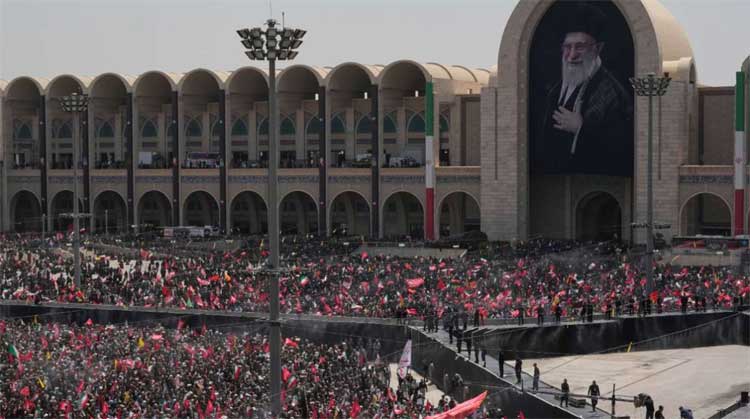
Iran is preparing for massive crowds in Tehran on Monday as the funeral procession of late Supreme Leader Ali Khamenei gets underway, with authorities taking extensive precautions to prevent a repeat of the deadly stampede that marred the funeral of his predecessor in 1989.
After lying in state for two days at Tehran’s Grand Mosalla religious complex, Khamenei’s coffin will be taken through the capital in a procession expected to last 10 to 12 hours, beginning at 6 a.m. local time.
Officials remain mindful of the chaos that unfolded during the 1989 funeral of Ayatollah Ruhollah Khomeini, when millions of mourners overwhelmed security arrangements. More than 10 people were killed and over 10,000 injured in crowd surges, while authorities were ultimately forced to transport Khomeini’s body by helicopter after mourners stormed the funeral vehicle.
This time, Iranian authorities have erected massive concrete barriers around Khamenei’s coffin while it lay in state, limiting public access in an effort to prevent dangerous overcrowding.
Thousands gathered at the Grand Mosalla on Sunday to pay their respects to Khamenei and four members of his family, who were killed in Israeli airstrikes on February 28 that Iran says were based on US intelligence.
A display of resilience
Beyond honouring the leader who ruled Iran for more than three decades, the funeral ceremonies are also being used by Tehran to project unity and resilience after weeks of conflict with Israel and the United States.
Parliament Speaker Mohammad Bagher Ghalibaf praised what he described as the overwhelming public turnout, saying Iranians had united to honour their “martyr.”
Following Monday’s procession in Tehran, funeral events will continue in the clerical city of Qom on Tuesday, Iraq’s holy cities of Najaf and Karbala on Wednesday, before Khamenei is buried in his hometown of Mashhad on Thursday.
Questions over succession
Three of Khamenei’s sons made a rare public appearance during Sunday’s ceremonies, drawing attention to the continued absence of Mojtaba Khamenei, who was named supreme leader after his father’s death but has yet to appear publicly.
Iranian officials have acknowledged that Mojtaba was injured in the February 28 airstrikes, though they have not disclosed the extent of his injuries.
Several senior military figures also attended the ceremonies, including Revolutionary Guards commander Ahmad Vahidi and Quds Force chief Esmail Qaani, both making high-profile appearances after maintaining a low profile during the recent conflict.
Notably absent, however, were Iran’s surviving former presidents, many of whom had strained relationships with Ali Khamenei during his decades in power.
Calls for revenge
Iranian authorities are also seeking to showcase public support after months of domestic unrest and anti-government protests that rights groups say were met with a deadly crackdown.
With the conflict between Iran, Israel and the United States currently paused under a ceasefire, calls for retaliation have dominated the funeral gatherings.
Many mourners demanded punishment for those responsible for Khamenei’s death, while reaffirming support for Iran’s leadership and its long-standing policy of backing anti-US and anti-Israel groups across the Middle East, including Hamas and Hezbollah, both of which sent delegations to the ceremonies.
Comments are closed.