
Marco Rubio seeks to repair relations with Pope Leo XIV as US-Vatican tensions simmer

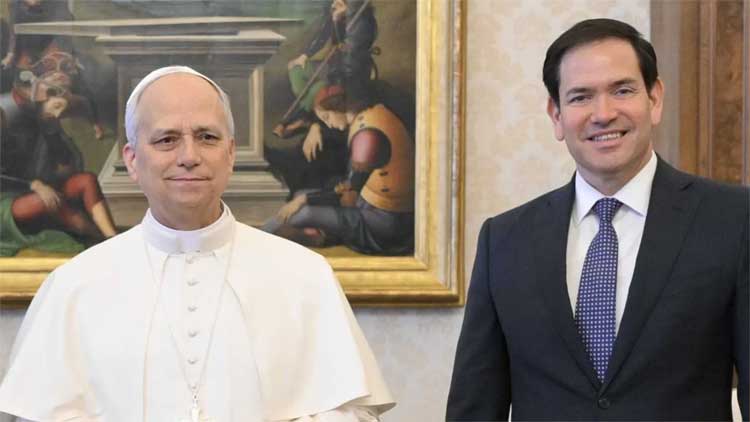
US Secretary of State Marco Rubio will meet Pope Leo XIV at the Vatican on Thursday in a bid to ease growing tensions between Washington and the Holy See, while also advancing President Donald Trump’s foreign policy priorities.
Rubio’s visit comes weeks after Trump publicly criticised the first American pope over his anti-war positions, exposing an unusually sharp rift between the White House and the Vatican.
The US secretary of state, a devout Catholic, attempted to downplay the dispute ahead of the meeting, which will also include talks with Vatican Secretary of State Pietro Parolin.
Parolin said Wednesday that the Vatican would hear Rubio out, noting that Washington had requested the meeting.
“There’s a lot to talk about with the Vatican,” Rubio told reporters before departing for Rome, citing issues including religious freedom — an area where both sides broadly align.
The Trump administration had initially welcomed Leo’s historic election on May 8, 2025, making him the first US-born pope in the history of the Catholic Church.
Relations, however, have since deteriorated sharply.
Last month, Trump launched an extraordinary public attack on the pontiff, calling him “weak on crime, and terrible for foreign policy” in a social media post.
The criticism followed Leo’s calls for peace in the Middle East conflict involving Israel and the United States, as well as his condemnation of Trump’s warning to destroy Iranian civilisation, which the pope described as “truly unacceptable.”
Speaking at a Vatican event on Wednesday, Parolin acknowledged the tensions and said discussions with Rubio would inevitably address recent disagreements.
“I imagine we’ll talk about everything that’s happened in recent days — we can’t avoid touching on these topics,” he said.
The Vatican also expects discussions on international issues including Latin America, Cuba and Lebanon.
The Holy See has historically played an important diplomatic role in Cuba, while Rubio — a Cuban-American — has spearheaded the Trump administration’s hardline approach toward Havana’s communist government.
Leo is also deeply familiar with Latin America after spending two decades as a missionary in Peru, where he later obtained citizenship.
Despite attempts to cool tensions, Trump renewed his criticism of the pope in an interview on Monday, accusing Leo of believing it was acceptable for Iran to possess nuclear weapons.
“I think he’s endangering a lot of Catholics and a lot of people,” Trump said.
Responding to the remarks, Leo defended the Church’s long-standing position against nuclear weapons and said its mission was to “preach peace” and the Gospel.
“If anyone wishes to criticize me for proclaiming the Gospel, let them do so truthfully,” the pope told reporters.
“The Church has spoken out against all nuclear weapons for years.”
Parolin also defended the pontiff, saying criticism of the pope seemed “a little strange,” adding: “The pope is being the pope.”
Leo’s American nationality has given his comments greater resonance in Washington than those of previous popes, particularly as he has openly criticised the Trump administration’s immigration crackdown and adopted increasingly strong anti-war positions.
Rubio and the pope previously met at the Vatican last year alongside US Vice President JD Vance, shortly after Leo’s election.
Comments are closed.