
Typhoon Bavi slams eastern China after mass evacuations; 134 injured in Taiwan

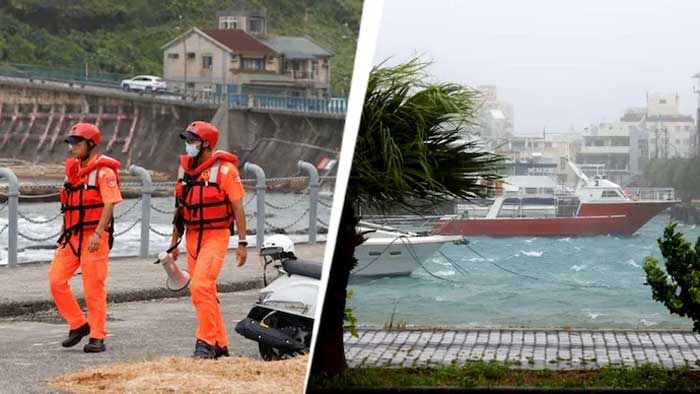
Emergency teams worked across China’s eastern coast on Sunday to clear roads blocked by fallen trees after Typhoon Bavi—the strongest storm to hit the country this year—made landfall, triggering floods and landslides and forcing nearly two million people to evacuate.
Although Bavi weakened into a tropical storm after moving inland, weather officials warned that it could continue to bring widespread heavy rainfall across eastern and northern China.
The typhoon first struck Yuhuan in Zhejiang province late Saturday night before making a second landfall in nearby Yueqing around midnight, packing maximum winds of up to 144 kmph (90 mph).
In Yueqing, more than 1,300 trees were brought down, including over 700 uprooted, while flooded streets and landslides disrupted normal life. State media showed massive boulders crashing onto mountain roads and swollen rivers inundating surrounding areas.
Authorities evacuated nearly two million people before the storm’s arrival, including 1.72 million residents in Zhejiang, more than 130,000 in Fujian province, and around 34,000 people from vulnerable coastal areas of Shanghai. Schools, workplaces, public transport and outdoor activities were suspended in parts of Zhejiang, while more than 400 flights and dozens of train services were canceled.
Before reaching mainland China, Bavi lashed northern Taiwan with torrential rain and strong winds, dumping nearly 80 cm of rain in parts of Miaoli County. Taiwan reported 134 injuries, mostly from weather-related accidents, but no fatalities. The storm also led to the cancellation of 199 flights and left over 170,000 households without electricity.
Earlier, Bavi swept across Japan’s southwestern islands, causing widespread power outages and flight cancellations that affected more than 26,000 passengers.
In the Philippines, the storm’s impact pushed the death toll from heavy rain and landslides to 18, while nearly 11,000 people were displaced and dozens of ports remained shut.
The typhoon arrived amid days of severe weather across southern and central China that has already killed at least 39 people, caused rivers to overflow and led to the collapse of a reservoir dam.
Climate experts say rising ocean temperatures are fueling stronger tropical cyclones by providing additional heat and moisture, while the return of the El Niño weather pattern is expected to further influence conditions across the Pacific this year.
Comments are closed.