
US-China Trade Truce Buys Time, But Strategic Rivalry Deepens

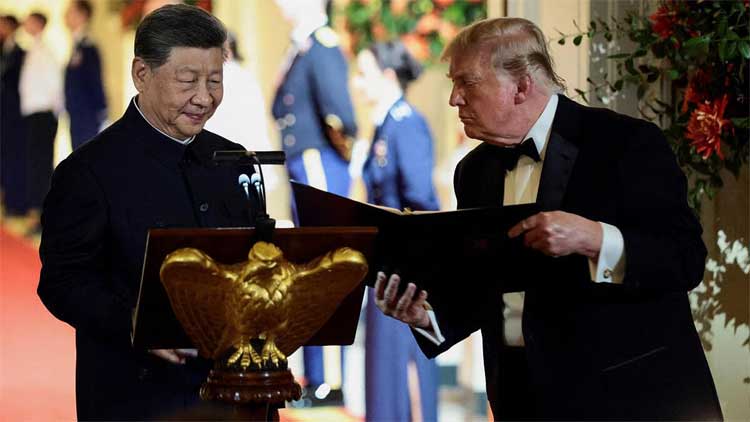
The United States and China may have bought themselves some breathing room by extending their trade truce, but analysts warn that the pause may do little to resolve the deeper strategic rivalry between the world’s two largest economies.
US President Donald Trump and Chinese President Xi Jinping wrapped up a high-profile summit on Friday, with Trump confirming that the two leaders plan to meet twice more this year.
But despite the diplomatic overtures, the underlying tensions remain. Daniel Russel of the Asia Society Policy Institute said the US and China “remain locked in a bitter competition” over trade, technology, Taiwan, defence, rare earths and industrial policy.
Daniel Kritenbrink, a former US official now with consultancy The Asia Group, said both leaders appear to want stability in bilateral ties, at least through the end of the year.
However, he said the truce would need to deliver “further tangible outcomes” if it is to hold over the longer term.
Kritenbrink also pointed to concerns among US officials that Beijing has not fully delivered on commitments made during previous meetings, saying some officials have expressed “profound frustration” with China.
US-China Trade Truce Extended
Trump and Xi had agreed to a trade truce last year during a meeting in South Korea, following a sharp escalation in tariffs that saw duties between the two countries climb above 100% at one stage.
Under the agreement, Beijing committed to purchasing additional US soybeans and other agricultural products while suspending restrictions on rare earths for one year.
The agreement had been due to expire in November. However, the two sides agreed this week to extend the truce until January 10, US Treasury Secretary Scott Bessent said.
Washington Keeps China On ‘Short Leash’
US Trade Representative Jamieson Greer told CNBC on Friday that Washington views such extensions as “compliance periods.”
Kritenbrink said US officials believe China is doing only enough to preserve the agreement, warning that such an approach would be difficult to sustain over the long term.
Mary Lovely of the Peterson Institute for International Economics said the shorter extension was the preferred option for Washington.
According to Lovely, Beijing would have preferred a longer extension, while the US appears particularly concerned about the supply of rare earth magnets and wants to keep the arrangement under close scrutiny.
She also questioned how effective threats of higher tariffs remain in influencing Beijing.
US, China Seek Further Trade Outcomes
Greer said the two countries have made progress on additional economic issues and are expected to release more details on Monday.
He said Washington wants to identify a group of products that could be traded with China under more preferential terms. The two sides have also agreed on certain products that could be kept outside future trade disputes.
Greer is scheduled to host G20 trade ministers in Wisconsin next week. US tariff threats and Chinese industrial overcapacity are expected to be among the issues discussed.
AI Cooperation Faces Challenges
Washington and Beijing have also agreed to establish some form of notification mechanism for artificial intelligence-related threats between the two countries, Bessent said.
Peter Richardson of Counterpoint Research said the mechanism could be as straightforward as a hotline, although defining which incidents should trigger communication could prove difficult.
He noted that it can be challenging to quickly determine whether an AI-related incident was directed by a government, caused by an individual actor or resulted from an accident.
Richardson said the arrangement is unlikely to produce a comprehensive international framework for AI regulation given the broader US-China rivalry, but could serve as an initial practical safeguard.
Kritenbrink said the summit had done little to reduce competition between Washington and Beijing in AI.
“I don’t think you’ll see any slowing down,” he said.
Comments are closed.