

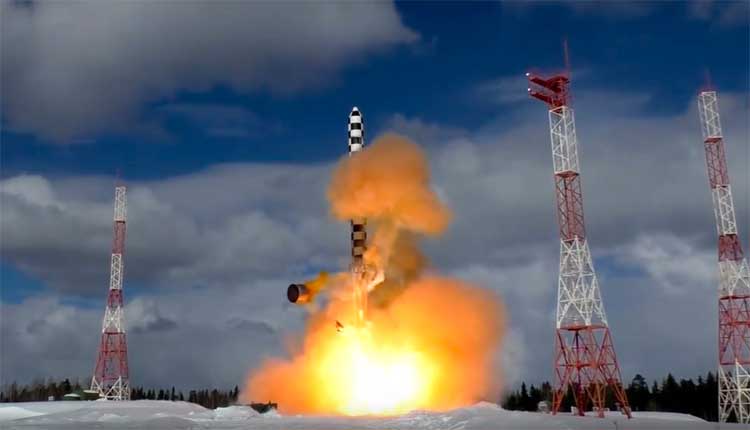
Russia on Tuesday tested a new long-range missile capable of carrying nuclear warheads, months after the last arms control treaty limiting the atomic arsenals of Moscow and Washington formally expired.
The lapse of the New START agreement in February removed the final major restrictions on the world’s two largest nuclear powers.
Calling it “the most powerful missile system in the world,” Vladimir Putin announced the successful launch of the Sarmat intercontinental ballistic missile (ICBM), saying it would enter combat duty by the end of the year.
Putin claimed the missile could carry warheads far more powerful than those possessed by Western militaries.
Despite Russia and the United States reopening high-level military dialogue after the treaty’s expiry, there have been no visible moves toward negotiating a replacement pact.
US President Donald Trump has repeatedly pushed for any future nuclear arms agreement to include China, whose nuclear stockpile remains smaller than those of Russia and the US, though Beijing has rejected the proposal.
Signed in 2010, the New START treaty was the last remaining Cold War-era framework limiting deployed strategic nuclear weapons. Both Moscow and Washington had repeatedly accused each other of violating its terms.
The Sarmat missile — dubbed “Satan II” by NATO — is the first “super-heavy” ICBM developed by post-Soviet Russia. Putin said it is capable of traveling up to 35,000 kilometres (22,000 miles).
Comments are closed.