
Ebola outbreak spreads in eastern DR Congo’s Mongbwalu amid denial and mistrust

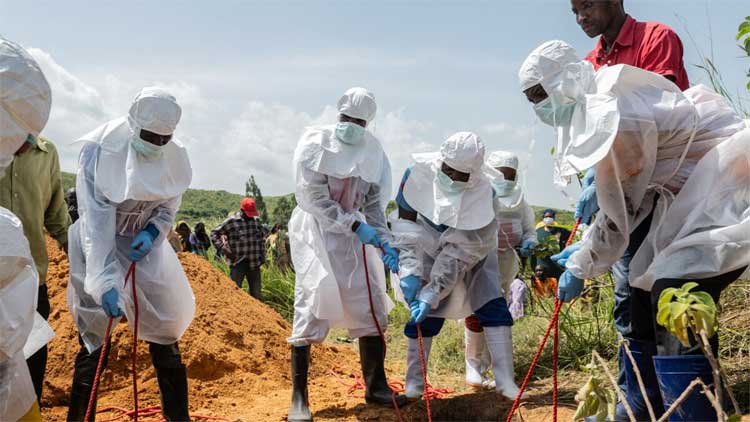
In Mongbwalu, a gold-mining town in eastern Democratic Republic of Congo’s Ituri province, residents are grappling with a fast-moving Ebola outbreak that has fuelled both fear and denial in one of the country’s most conflict-affected regions.
Unlike some locals who question whether the virus exists, 26-year-old resident Laureine Sakiya says she is convinced after witnessing neighbours die from the disease.
“The authorities need to bring us vaccines,” she said.
But no vaccine or specific treatment is available for the Bundibugyo strain of Ebola behind the current outbreak, the country’s 17th since the disease was first identified.
Rising toll and spread
Since Congo’s health ministry declared the outbreak on May 15, the virus has spread beyond Ituri province into neighbouring regions and even across the border into Uganda, prompting the World Health Organization to declare an international emergency.
In Mongbwalu alone — one of the earliest epicentres — authorities report 339 suspected cases and 88 deaths. Nationwide, the health ministry has recorded 867 suspected cases and 204 deaths, though officials and aid workers say the true toll may be higher due to limited testing capacity.
“The epidemic is out of the ordinary,” said Florent Uzzeni, a coordinator with Médecins Sans Frontières (MSF), warning that surveillance and laboratory capacity remain stretched.
‘Mystical malady’ fears and mistrust
In Mongbwalu, where mud-covered motorbikes weave through busy streets linking mineral-rich areas near Uganda and South Sudan, long-standing distrust of state institutions has complicated the response.
Some residents describe the disease in spiritual terms or deny its existence entirely — a pattern seen in past Ebola outbreaks in the region.
“At the beginning, people believed it was a coffin affair,” said civil society leader Jonathan Imbalapay, referring to early rumours that a damaged coffin had spread illness after a body was transported from Bunia, the provincial capital.
According to local accounts, the first suspected case was identified in Bunia before the body was returned to Mongbwalu. During the journey over rough roads, the coffin was reportedly damaged, leading to fears of contamination and prompting attempts by some traditional leaders to burn it.
When early provincial tests failed to confirm Ebola, confusion deepened and allowed the virus — and panic — to spread further until samples sent to Kinshasa’s biomedical laboratory, nearly 1,800 kilometres away, confirmed the outbreak.
Response under strain
Inside Mongbwalu’s hospital, health workers in full protective suits disinfect wards with chlorine while isolating suspected patients in tents provided by MSF. Handwashing stations, however, still rely on buckets, underscoring the limited resources available on the front lines.
Aid groups say the response is constrained by weak infrastructure and mistrust among communities already scarred by years of conflict and neglect.
Adam Hussein, a 35-year-old representative of local traditional healers, warned against misinformation.
“I worry about those who say that this disease is invented,” he said, urging residents to take precautions as health teams try to contain the outbreak.
As the virus spreads through a region shaped by mining, displacement and insecurity, officials warn that controlling it will depend not only on medical intervention, but also on rebuilding trust in public health efforts.
Comments are closed.