
Trump’s DC triumphal arch wins preliminary approval from federal commission

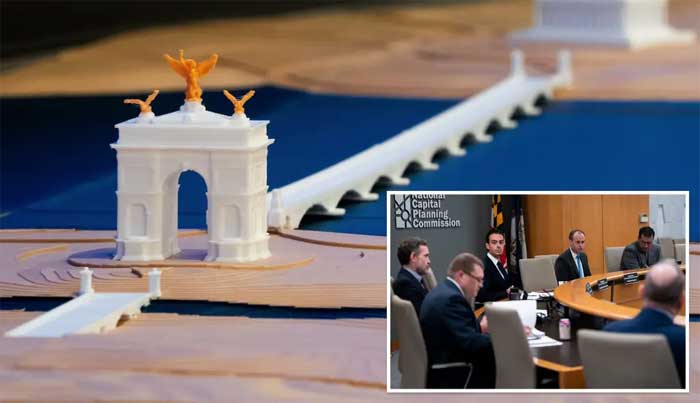
President Donald Trump’s proposal to build a 250-foot (76-metre) monumental arch in Washington, DC, won preliminary approval from a key federal planning commission on Thursday, moving one step closer to construction despite strong public opposition.
The National Capital Planning Commission (NCPC) voted to approve the project’s initial site and building plans for the arch, which would be built at Memorial Circle on the Virginia side of the Memorial Bridge. However, commissioners postponed a decision on whether the federal Height of Buildings Act applies to the project.
The proposed monument is part of Trump’s broader effort to reshape parts of the US capital, alongside projects including a new White House ballroom and other federal building initiatives.
Height law question deferred
NCPC staff had recommended granting preliminary approval while requiring design changes to ensure compliance with the Height of Buildings Act. The suggested modifications included redisuting the height between the arch itself, its planned observation deck and the statues that would crown the structure.
Instead, commissioners led by Chairman Will Scharf decided to delay ruling on whether the height restrictions apply at all.
Scharf said the Interior Department, which oversees the federal land where the arch would be built, had presented a legal argument that the law is not binding on federal government projects.
“My view is that today we are just considering this project for preliminary approval,” Scharf said, adding that the commission could revisit the legal question before a final vote, which is expected as early as September.
Eight of the commission’s 12 members voted in favour of preliminary approval, one voted against and three abstained.
Critics cite location, scale and symbolism
Dozens of members of the public addressed the commission, with many opposing the project.
Several speakers argued that placing a celebratory monument next to Arlington National Cemetery would be inappropriate. Others said the arch would be better suited to a location closer to the Capitol or Washington’s sports and entertainment district.
Vietnam veteran Michael Lemmon, one of several plaintiffs suing to block the project, said the monument would disrespect those buried at Arlington.
“As a combat veteran, I feel a duty to protect the memory and honour the sacrifice of my comrades and all those buried there,” he said. “This vainglorious monumental arch does neither.”
Opponents also argued that the structure would disrupt the historic sightline between the Lincoln Memorial and Arlington National Cemetery, a vista designed to symbolise national reunification after the Civil War.
At 250 feet tall, the arch would stand more than twice the height of the 99-foot Lincoln Memorial and nearly half as tall as the 555-foot Washington Monument.
Other concerns raised included traffic congestion, pedestrian safety and whether Congress should be required to authorise construction.
Cost remains unclear
The US Commission of Fine Arts approved the arch’s design in May, while the NCPC began reviewing the proposal in June.
Trump has said the monument would commemorate the 250th anniversary of American independence and initially suggested it could be financed using unused private donations raised for the new White House ballroom project.
However, the administration has since indicated that public funds will also be used for both projects. The White House has not released an estimated cost for the arch.
Comments are closed.