
Air safety probe after Trump’s Marine One reportedly comes too close to passenger plane

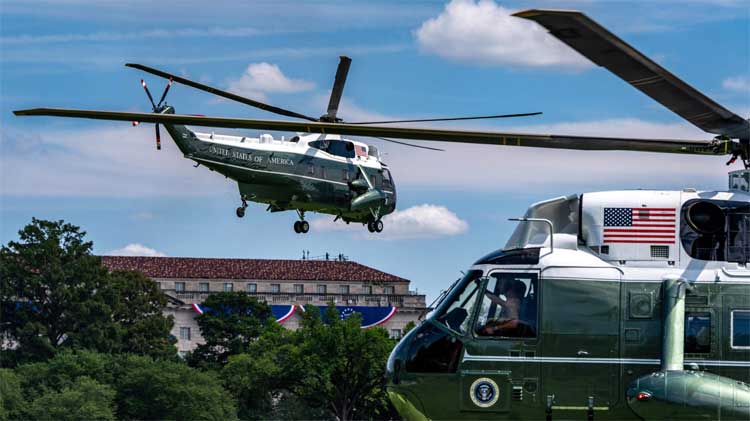
US aviation authorities are investigating a reported air safety incident involving Marine One, the presidential helicopter carrying President Donald Trump, and a commercial passenger aircraft near Washington, DC.
The incident occurred on August 4 as Marine One flew from the White House to Andrews Air Force Base while an American Airlines regional jet departed Ronald Reagan Washington National Airport. Reports said the two aircraft came closer than the prescribed minimum safety distance, triggering a federal investigation into a possible “loss of separation” event.
The National Transportation Safety Board (NTSB) has opened an inquiry, while the Federal Aviation Administration (FAA) said air traffic controllers remained in communication with both the Marine One crew and the commercial flight throughout the incident.
The White House stressed that Trump was never in danger.
“Marine One flights are piloted by some of the best aviators in the world, and at no point was the president in harm’s way,” White House spokesperson Kush Desai said. He added that the incident is under review and that appropriate corrective measures would be taken if necessary.
Initial reports suggest communication issues with air traffic control may have contributed to the incident. Under US aviation safety rules, aircraft are generally required to maintain at least 1.5 miles of horizontal separation and 500 feet of vertical separation.
The passenger aircraft involved was identified as an American Airlines Embraer E-170 operated by Envoy Air. After landing at Andrews Air Force Base, Trump transferred to Air Force One for his trip to California.
The US Marine Corps rejected suggestions that Marine One was involved in a near collision.
“There were no ‘close calls’ with the routine Marine One movement,” Marine Corps spokesperson Captain Jacob Sugg said, adding that controllers did not instruct the helicopter crew to delay, hold position or alter their planned route.
The investigation comes amid heightened scrutiny of flight operations around Washington National Airport following the deadly January 2025 collision between a commercial airliner and a US Army Black Hawk helicopter that killed 67 people. Earlier investigations also uncovered long-standing communication issues between military and civilian air traffic control systems in the region.
Comments are closed.