
US completes fresh Iran strikes as Trump threatens tougher retaliation

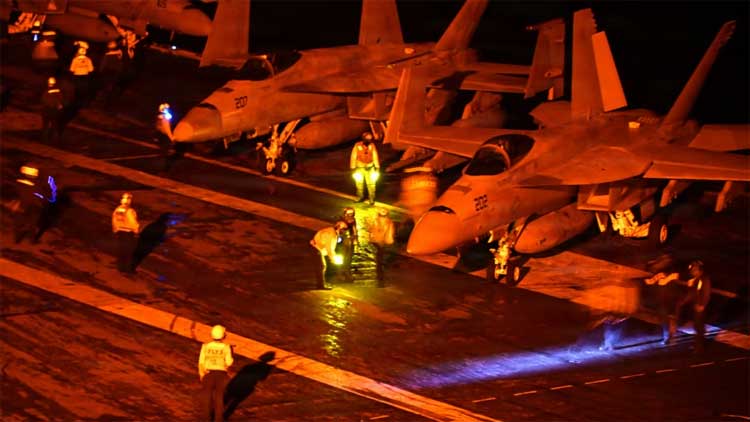
The United States launched fresh strikes on Iranian military targets Tuesday, prompting Tehran to retaliate with missiles and drones against American interests across the Middle East as a six-month-old conflict threatened to erupt into a wider war.
US Central Command said it had completed the latest wave of attacks against Iranian air-defence systems, radar installations and maritime assets. The strikes followed a separate round of US attacks Sunday that ended a month-long lull in fighting.
The renewed hostilities have pushed global oil prices higher and created growing political challenges for President Donald Trump ahead of the November midterm elections.
Trump said late Tuesday that he was not seeking to force Iran back to the negotiating table.
“I couldn’t care less if they sign a worthless, to them, agreement,” Trump said in a social media post, adding that he preferred Washington’s position with “almost total control of the Hormuz Strait” and an Iranian economy that was “totally collapsing.”
Earlier, Trump had signalled that Washington was relying on economic pressure and sanctions to force Tehran into concessions. He also warned that Iran would face attacks “at a much harder and higher level” if it retaliated.
US Central Command said the latest strikes were carried out after Iran allegedly attempted to attack commercial vessels and US forces in the region. Trump separately told Fox News that American forces had targeted Iranian radar systems that Tehran was attempting to rebuild.
“They tried to rebuild their radar because they can’t see anything,” Trump said. “We waited until it was almost built and then we hit it.”
Iran retaliates across the region
Following the US strikes, Iran launched ballistic missiles toward Jordan, according to Iranian state television. Iran’s Revolutionary Guard said it had targeted a US military base along Jordan’s Gulf of Aqaba coast.
Jordan’s military said its air defences intercepted 10 Iranian missiles, while three others landed in unpopulated areas. Explosions believed to be missile interceptions were seen over Aqaba.
Iranian state media also accused the US of striking civilian sites along Iran’s southern coast and attacking a civilian airport.
One US strike hit a home in Kuhestak where a wedding ceremony was taking place, killing five people, including a child, and injuring at least 68 others, according to Ahmad Nafisi, deputy governor of Hormozgan province.
“Make no mistake: these crimes will not go unpunished,” Ebrahim Azizi, chairman of the Iranian parliament’s National Security and Foreign Policy Committee, said on X.
US Central Command acknowledged reports of civilian casualties but said they originated from Iranian state media. Capt. Tim Hawkins, a CENTCOM spokesperson, said the US military “never targets civilians, unlike the IRGC.”
Kuwait’s military said its air defences intercepted Iranian drone attacks, while Iran claimed to have targeted US forces in Bahrain with drones. Bahrain said its air defences intercepted the attacks.
Iran threatens ‘crushing and devastating blows’
Iran’s Armed Forces General Staff and joint military command vowed to deliver what they described as “crushing and devastating blows” against the United States.
The state-run IRNA news agency also quoted the Revolutionary Guard as saying the attacks had strengthened Iran’s resolve and further tightened its effective closure of the Strait of Hormuz, a crucial global oil route that normally carries around 20% of the world’s petroleum supplies.
Explosions were reported across several southern coastal areas, including Bandar Abbas, home to Iranian naval and air-force facilities, as well as Qeshm Island in the Strait of Hormuz.
Witnesses in Bandar Abbas told The Associated Press that the explosions appeared stronger than those reported Sunday, with smoke rising from the eastern part of the city.
Iranian state television said US strikes hit a fishmeal factory on Qeshm Island and other civilian locations in Hormozgan province, including a fishing pier and a Ports and Maritime Organization tower in Sirik.
State television also reported that the US military struck Jiroft Airport in Kerman province. Iranian officials said a projectile landed outside the runway and caused no casualties or damage to airport infrastructure.
Iran’s electricity grid operator, Tavanir, said parts of the power network in Hormozgan had also been hit, causing outages that authorities were working to restore.
Hormuz remains at centre of conflict
The United States and Iran remain locked in a struggle over the Strait of Hormuz, a narrow waterway off Iran’s coast that serves as one of the world’s most important oil-shipping corridors. Tehran effectively closed the strait after the war began, while Washington has sought to challenge Iran’s control over the route.
Oil prices surged again following Tuesday’s strikes. Crude was already up around 7% for the week, while prices have risen more than 50% this year, pushing US gasoline prices higher.
The average price of regular gasoline in the United States rose to about $4.10 a gallon, compared with $3.19 at the same time last year, according to AAA.
Ceasefire hopes fade as fighting resumes
The latest escalation came despite Iranian President Masoud Pezeshkian saying earlier Tuesday that Tehran was prepared to return to an interim ceasefire agreement reached with Washington in June if the United States did the same.
“If the U.S. returns to its commitments in the memorandum of understanding, the Islamic Republic of Iran will immediately reciprocate,” Pezeshkian said, according to Iranian state media, while attending the Shanghai Cooperation Organization summit in Kyrgyzstan.
The June agreement called for an immediate ceasefire and opened a 60-day window for negotiations toward a broader settlement. The arrangement later collapsed.
In Sunday’s strikes, US Central Command said American forces had targeted Iranian rocket launchers that could be used to deploy sea mines in the Strait of Hormuz.
Iran responded by firing missiles toward US positions in Jordan, which were intercepted. The United Arab Emirates also said it had intercepted an Iranian drone over its waters.
Washington has described the renewed fighting as limited, with Central Command reiterating Tuesday that its latest strikes followed what it called Iranian attacks against commercial shipping and US troops in the region.
Comments are closed.