
Thousands of ISRO Employees Raise Concerns Over Future Amid Privatisation Push

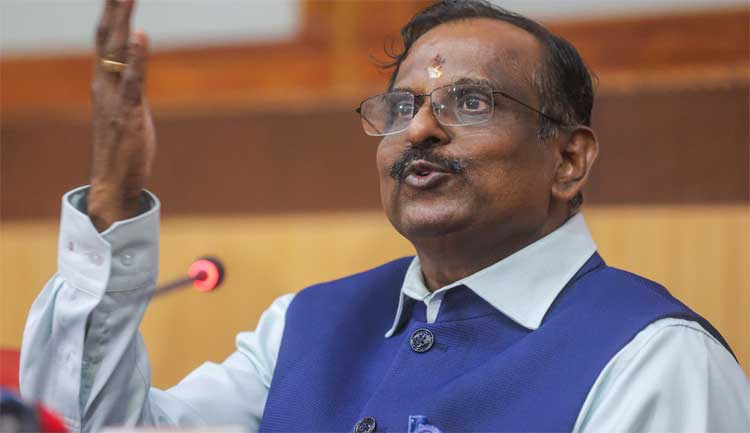
Six years after the government opened India’s space sector to private players, nine associations representing thousands of ISRO employees have sought official clarification on plans to transfer the space agency’s manufacturing and operational functions to private entities.
In a September 4 letter to ISRO chairman and Department of Space (DoS) secretary V Narayanan, the associations sought clarity on the government’s privatisation policy, ISRO’s future role and its implications for existing employees and future recruitment.
Employee bodies representing several ISRO centres signed the letter, seen by HT. They include the ISRO Staff Association, SHAR Employees Association, ISAC Employees Association, ISRO Staff Association-LPSC, ISRO Staff Association-BBU, NRSA Employees Union, Space Employees Association-BBU, ISRO Staff Association-IPRC and SAC Employees Welfare Association.
The associations’ concerns followed remarks by Pawan Kumar Goenka, chairman of the Indian National Space Promotion and Authorisation Centre (IN-SPACe), at a recent event that “eventually, ISRO will not make any launch vehicles and will not manufacture any launch vehicles. That will all be done by the private sector or PSU.”
Goenka said the transition had already begun with the Small Satellite Launch Vehicle (SSLV) and could eventually extend to the Polar Satellite Launch Vehicle (PSLV) and LVM3.
The employee bodies also flagged reports about plans to transfer production of these launch vehicles, move routine satellite manufacturing outside ISRO and open new launch infrastructure, including the Space Launch Complex at Kulasekarapattinam, to private entities. They also pointed to around 120 technologies that have already been transferred from ISRO to private companies.
“These statements have received wide national publicity. They have not, however, been accompanied by any corresponding official communication from the Department of Space to its employees explaining the approved policy, its legal and administrative basis, its phasing, or its consequences for the existing workforce and for future public recruitment,” the associations said.
They said the possibility of ISRO withdrawing from launch-vehicle and satellite production had caused anxiety among employees and their families.
According to the associations, such a shift could “tamper experiments after research, shrink in-house work, freeze or reduce sanctioned strength, and close promotion and skill-development avenues” across technical, scientific, administrative, stores, purchase, quality, safety and industrial cadres.
The employee bodies stressed that launch-vehicle design, development, integration, testing and launch operations were central to ISRO’s institutional expertise and strategic capabilities.
“Launch-vehicle design, realisation, integration, testing and launch operations are not merely ‘manufacturing contracts’. They are the core competence, institutional memory and strategic capability of the Organisation,” the letter said.
Comments are closed.