
Syria Details Efforts to Address Assad-Era Chemical Weapons Legacy at OPCW Meeting in The Hague

A Syrian delegation attending a meeting of the Organisation for the Prohibition of Chemical Weapons (OPCW) in The Hague has outlined efforts to address the chemical weapons legacy of the country’s ousted regime and called for greater international cooperation on mine clearance and post-conflict recovery, the Syrian Arab News Agency (SANA) reported on Thursday.
The delegation, led by Emergency and Disaster Management Minister Raed Al-Saleh, held a series of bilateral meetings on the sidelines of the 31st Session of the Conference of the States Parties to the Chemical Weapons Convention.
According to SANA, discussions focused on addressing Syria’s inherited chemical weapons programme, supporting survivors, preserving evidence and national memory, and advancing justice and reparations for victims.
The Syrian delegation, which included the country’s Permanent Representative to the OPCW, Mohammad Katoub, met representatives from Denmark, Norway, Finland and Sweden to explore opportunities for international cooperation on these issues.
The team also held discussions with a German delegation headed by Darius Rahimi-Laridjani, Germany’s Federal Government Commissioner for Arms Control, Non-Proliferation and Disarmament. The talks focused on providing assistance and training to specialised Syrian teams operating under the “Breath of Freedom” task force.
Syria seeks international support for reconstruction
During separate meetings with Dutch Deputy Prime Minister and Minister of Asylum and Migration Bart van den Brink and Dutch Minister of Foreign Trade and Development Cooperation Sjoerd Sjoerdsma, Al-Saleh discussed support for the government’s “Syria Without Camps” initiative.
The initiative aims to establish conditions that would allow displaced Syrians to return safely to their homes and communities.
The discussions also covered mine clearance, the removal of explosive remnants of war, rehabilitation of infrastructure and agricultural land, and broader reconstruction and recovery efforts.
SANA reported that the Syrian delegation subsequently met the Netherlands’ Permanent Representative to the OPCW and the International Criminal Court, Govert Jan Bijl de Vroe, along with Deputy Permanent Representative Mark Groen.
Syrian officials welcomed Dutch assistance in helping Damascus restore its rights and privileges within the OPCW, eliminate the remnants of the former regime’s chemical weapons programme and expand mine-clearance operations.
The delegation also called for a joint roadmap and timetable to complete inspection and destruction activities. The proposed plan aims to end exceptional measures imposed on Syria and enable the country to fully resume its role under the Chemical Weapons Convention.
Syria, Ukraine discuss demining cooperation
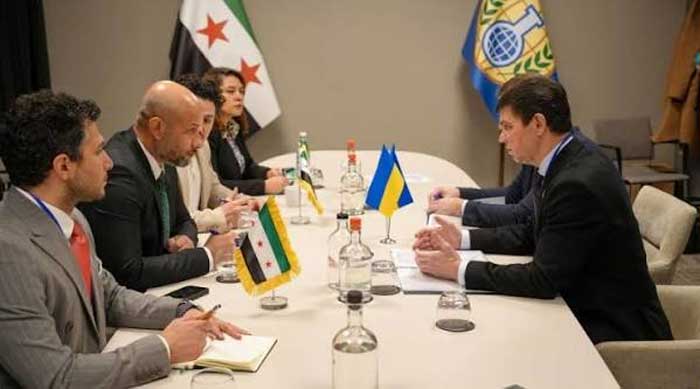
Al-Saleh also met Ukrainian Deputy Foreign Minister Olexandr Mischenko to discuss cooperation in mine clearance, specialised personnel training and the exchange of technical expertise to support Syria’s recovery.
Earlier this week, Al-Saleh told delegates at the OPCW conference that Syria had taken “important practical steps” towards addressing the chemical weapons legacy inherited from the former regime.
He highlighted the verified destruction of the first chemical missile from the inherited stockpiles under OPCW supervision, describing it as a significant milestone in the process.
The Syrian government’s efforts are part of a broader push to address the country’s chemical weapons legacy, strengthen international partnerships and support recovery following years of conflict.
Comments are closed.