
Macron deploys Versailles’ grandeur in a high-stakes bid to win over Trump

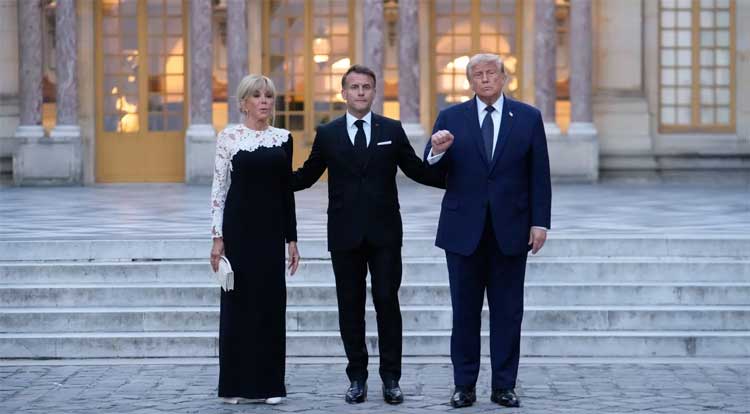
Donald Trump summed up the appeal in a single sentence: “Versailles is not gold leaf — Versailles is the real deal.”
For French President Emmanuel Macron, that was exactly the point.
On Wednesday evening, Macron opened the doors of Louis XIV’s palace to the American president for a private reception, performance, and dinner commemorating the United States’ 250th anniversary. At a moment of strain in the transatlantic relationship, the event offered Macron an opportunity to preserve a direct personal channel with Trump as the two leaders navigate disagreements over Iran, Ukraine, and trade.
The invitation had already achieved one immediate objective: keeping Trump at the Group of Seven summit through its conclusion.
“I’m a fan of beautiful places,” Trump told reporters, explaining that he had considered leaving earlier until “a very nice man” invited him to dinner. Upon arriving at the château, he paused for photographs in front of its gilded doors.
The evening also served a practical diplomatic purpose. Speaking to TF1 earlier in the week, Macron said Trump “needs to stay until the end” to help finalize summit agreements.
For a French president, Versailles represents perhaps the ultimate display of national soft power: the Hall of Mirrors, the gardens of the Sun King, and centuries of carefully cultivated grandeur.
“Versailles is a diplomatic tool and an instrument of influence,” Macron said Wednesday. Comparing diplomacy to soccer, he added: “Whether I’m playing at home or away, my goal is to score goals. And when I host other teams, I try to give them a nice welcome.”
France may possess limited economic or military leverage over Washington, but pageantry remains one of the few instruments it can deploy effectively—though history suggests such displays rarely guarantee political results.
Soft Power Built in Stone
Macron and Trump have often disagreed on policy, yet their relationship has endured in part because Macron understands Trump’s appreciation for personal attention, grand settings, and symbolic gestures.
Their first meeting in 2017 produced the now-famous prolonged handshake that became an instant symbol of their competitive relationship. Months later came dinner at the Eiffel Tower and Trump’s place of honor at France’s Bastille Day parade.
Versailles elevates that strategy further, wrapping contemporary diplomacy in the authority and scale of French history.
“It is soft power based on hard buildings,” said Denis Lacorne, professor of American studies at Sciences Po.
Macron has used the palace before, hosting Russian President Vladimir Putin there in 2017 and later welcoming King Charles III and Queen Camilla for a state dinner.
For more than three centuries, Versailles has served as a stage for honoring foreign dignitaries, according to palace officials. Today, it remains “a place in the service of French diplomacy.”
The venue carries special significance for Trump. The former real-estate developer has long viewed architecture as an expression of status, success, and power. During his second term, he has pursued projects intended to leave a lasting physical legacy, including plans for a new White House ballroom and a 250-foot triumphal arch inspired by Paris’ Arc de Triomphe.
The Hall of Mirrors Effect
French media reported that the evening could include a visit to the Hall of Mirrors, a fountain display, and fireworks, though officials did not release the full program.
The Hall of Mirrors itself was once a technological marvel: 357 mirrors arranged across 17 arches along a 73-meter gallery, demonstrating that French craftsmen could rival Venice’s famed glassmakers.
Its design served a political purpose as well. Every royal entrance was multiplied endlessly across the glass.
“You will be reflected many, many times, from one mirror to another,” Lacorne noted.
For a president who has spent much of his second term adding gold accents to the Oval Office, the attraction is obvious.
In a sense, Trump was visiting a building he has referenced for years. He has often said that the ballroom at Mar-a-Lago was modeled after Versailles.
A Familiar Formula
World leaders have long recognized Trump’s appreciation for spectacle.
During the 2017 Bastille Day parade, tanks rolled down the Champs-Élysées, cavalry units passed in formation, and fighter jets streaked overhead trailing red, white, and blue smoke.
Trump later called it “one of the greatest parades I’ve ever seen.”
“We’re going to have to try and top it,” he said at the time. Years later, in 2025, he finally presided over a major Army anniversary parade in Washington.
China deployed a similar strategy during Trump’s 2017 visit, granting him a rare tour of the Forbidden City in what officials described as a “state visit plus.”
Britain followed its own playbook last September, welcoming Trump for a second state visit with mounted troops, a carriage procession, and a banquet at Windsor Castle.
The Limits of Flattery
The challenge for Macron is that ceremonial success does not necessarily translate into political gains.
Trump described the Windsor banquet as one of the greatest honors of his life. Yet admiration for the pageantry has rarely produced significant policy concessions.
The early Macron-Trump “bromance” has gradually given way to a more transactional relationship.
Trump has threatened tariffs of up to 100 percent on French wine and Champagne as part of broader trade disputes. France opposed U.S. military action against Iran, while Macron has continued pressing Washington to maintain support for Ukraine.
The Versailles dinner has also drawn criticism at home.
“We must learn once and for all to live without Trump,” said veteran far-left leader Jean-Luc Mélenchon.
Even so, Versailles offers Macron distinct advantages: centuries of diplomatic symbolism, a setting perfectly aligned with Trump’s taste for ceremony, and a destination already familiar to hundreds of thousands of American visitors each year.
History, however, urges caution. Ronald Reagan dined beneath the same mirrors during the 1982 G7 summit, and the grandeur of Versailles did little to resolve the major disagreements that remained afterward.
Comments are closed.