
Most Families Of Six US Soldiers Killed In Iran War Attack To Skip Trump’s Gold Star Event

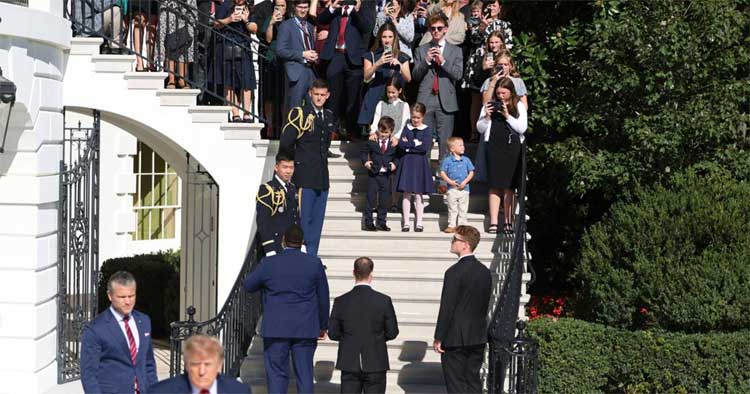
Most families of the six US service members killed in the deadliest attack of the Iran war are expected to skip a major White House reception for Gold Star families hosted by President Donald Trump on Tuesday.
Only one family member of the six soldiers killed in an Iranian drone strike on March 1 at Port Shuaiba in Kuwait confirmed to The Associated Press that they planned to attend the event with Trump and first lady Melania Trump.
Surviving troops who were present during the attack have questioned why the soldiers were stationed at a location that lacked adequate air defenses despite being considered a likely target.
The war, which began on February 28, has killed 19 US service members and wounded more than 800 others. The annual White House gathering marks Gold Star Mother’s and Family’s Day, observed during the last weekend of September.
The White House said this year’s reception would honor nearly 40 service members killed in conflicts dating back to the Vietnam War. Trump was expected to deliver remarks before a candle-lighting ceremony and a musical performance featuring “America the Beautiful.”
Families Seek Answers Over March 1 Attack
Families of the soldiers killed at Port Shuaiba have expressed frustration over what they describe as a lack of information from the Pentagon about the circumstances surrounding the attack.
Joey Amor, whose 39-year-old wife, Master Sgt. Nicole M. Amor, was among those killed, called for greater transparency in a public Facebook statement Monday.
“There are questions about what happened before the attack, what information was available, what decisions were made, and what happened in the moments leading up to six American soldiers losing their lives,” Amor said.
“I am done asking quietly,” he added, urging the public to stand with the six families and demand answers.
Several soldiers wounded in the attack also told AP that concerns they had raised about the threat were not acted upon. They additionally described problems with the military medical system in the weeks following the strike.
AP based its account of the March 1 attack on interviews with 13 soldiers.
The Army declined to comment on the report, saying it had not yet briefed the families of the dead soldiers on the findings of its investigation. The investigation was completed in June, but the Army said sensitive information was still being redacted before the findings could be released.
The Pentagon also declined to comment.
Families Report Confusion Over Invitations
John Thompson, a former Army sergeant and founder of Iowa-based Salute to the Fallen, said honoring fallen service members can provide an important recognition of their sacrifice.
However, he said several Gold Star families told him they could not attend because they were given insufficient notice.
The White House began sending invitations to Gold Star families — the military term for relatives of service members killed while on active duty — roughly two weeks before the reception, according to families who said they received phone calls and email invitations.
Thompson said there had been considerable confusion surrounding the event and that some families did not receive details in time. Travel costs also prevented some relatives from attending.
At least two families said they did not receive invitations, although locating and contacting relatives can sometimes be difficult because of changes in personal information.
Widow Of Fallen Soldier Says Family Should Have Been Invited
Tina Marzan, widow of Chief Warrant Officer 3 Robert Marzan, who was killed in the March 1 attack, said she and her two children were not invited to the reception.
Marzan said she had asked federal officials not to contact her in the immediate aftermath of her husband’s death after receiving multiple calls. However, she said she expected officials to make another attempt to reach her or other relatives for an event honoring Gold Star families.
“We should be there,” Marzan told AP. “I mean, that’s not a question.”
The White House said it does not contact individuals who have specifically requested not to be contacted.
Other relatives of service members killed during the war have offered different reasons for not attending.
Donna Burhans, mother of Maj. Cody Khork, another soldier killed at Port Shuaiba, said she did not receive an invitation but would not have attended because the event would be too painful.
Burhans, who has previously described herself as a “big fan” of Trump after meeting him during the dignified transfer at Dover Air Force Base, said she found it difficult to repeatedly relive her son’s death.
The White House said it attempted to send invitations to members of Khork’s family.
Some Families Criticise Trump Administration’s Handling
Some Gold Star families have praised the Trump administration and the military for honoring their loved ones, while others have criticised how the reception was organised and what they see as a lack of respect for the sacrifices their families have made.
Trump has also faced criticism over comments he made about the conflict. In the early stages of the war, he described it as a “little excursion,” and on September 4 referred to the conflict as “small potatoes.”
The spouse of Maj. Alex Klinner, an airman killed during an Iran-related combat operation this summer, said the short notice made it impossible to arrange overnight care for her three young children.
Libby Klinner said she would not have attended regardless, adding that she had “no interest in supporting an administration” she believed had acted recklessly with the lives of US service members.
The differing reactions highlight the deep divisions among Gold Star families over the war, the administration’s handling of the conflict and the military’s response to the deaths of their loved ones.
Comments are closed.