
Vijay’s entry triggers triangular contest, reshaping Tamil Nadu’s DMK–AIADMK rivalry

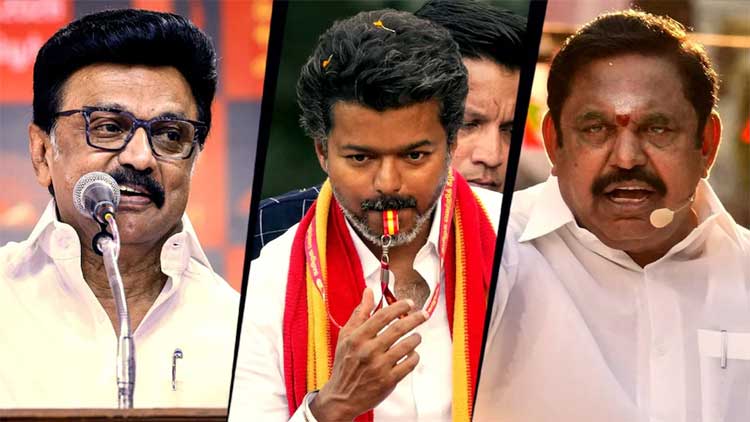
Tamil Nadu’s 2026 Assembly election is shaping up as a watershed moment, marking a shift from decades of bipolar politics to an increasingly competitive triangular contest. For years, power alternated between the Dravidian heavyweights — Dravida Munnetra Kazhagam and All India Anna Dravida Munnetra Kazhagam — but the entry of actor-turned-politician Vijay and his Tamilaga Vettri Kazhagam has disrupted this long-standing equation.
For over five decades, Tamil Nadu’s political landscape has been anchored in Dravidian ideology, with the DMK and AIADMK building deep-rooted vote banks, strong cadre networks, and welfare-driven campaigns. Even in recent elections, the contest remained largely two-sided. Under Chief Minister M K Stalin, the DMK reinforced its dominance with decisive wins in the 2021 Assembly elections and the 2024 Lok Sabha polls.
The AIADMK, though weakened after the death of J Jayalalithaa, continues as the principal opposition under Edappadi K Palaniswami. Despite organisational strains, it has retained a substantial voter base and leaned on alliances, including with the Bharatiya Janata Party, to remain competitive.
Vijay factor disrupts status quo
Vijay’s political debut has altered the dynamics significantly. One of Tamil cinema’s biggest stars, he has leveraged his mass appeal to build a political platform focused on anti-corruption, governance reforms, and social justice. The TVK has quickly cultivated a youth-driven support base, backed by grassroots mobilisation and strong digital outreach.
Through large rallies, social media campaigns, and initiatives like the “whistle” movement, the party has gained traction—especially among urban voters and first-time participants. Estimates suggest TVK could secure a 15–20% vote share, a notable feat for a newcomer in the state.
The party is positioning itself as a vehicle for generational change, targeting younger voters with promises of jobs, internships, and financial support. This strategy is significant in a state with a large youth electorate, including lakhs of first-time voters.
Welfare pitch and voter outreach
TVK has also made a strong push to attract women voters, who make up a slight majority of the electorate. Its promises include monthly financial assistance, free LPG cylinders, and marriage-related benefits—marking a strategic shift toward welfare politics traditionally dominated by Dravidian parties.
From bipolar to triangular contest
The emergence of TVK represents more than just a third contender—it signals a structural shift. The party is cutting into the support bases of both major players, drawing urban and youth voters from the DMK while also appealing to anti-incumbency sentiment that would typically favour the AIADMK.
This fragmentation has made electoral outcomes far less predictable. Even where TVK may not win seats outright, it could influence results by splitting votes, positioning itself as a potential kingmaker in several constituencies.
Changing alliance calculations
Tamil Nadu’s elections have historically relied on broad alliances to consolidate votes. TVK’s largely standalone approach has complicated these strategies, forcing both DMK and AIADMK to recalibrate.
The AIADMK is attempting to frame the election as a direct contest with the DMK to prevent division of opposition votes, while the DMK is doubling down on its governance record and welfare schemes to retain its base amid concerns of youth vote erosion.
Ground reality and voter perception
The triangular nature of the contest is especially visible in southern districts like Kanyakumari, Thoothukudi and Tirunelveli, as well as urban hubs such as Chennai, where TVK is reshaping voting patterns.
However, voter perception still leans toward the traditional binary. Surveys suggest a significant portion of the electorate continues to see the race as primarily DMK versus AIADMK, with fewer recognising it as a genuine three-way contest.
Stakes for major players
For Stalin’s DMK, governance, welfare delivery, and social justice remain key strengths, with strong backing among minorities, Dalits, and sections of the middle class. The challenge lies in countering anti-incumbency and holding onto younger voters.
For the AIADMK, the main advantage is its ability to consolidate anti-incumbency sentiment against the ruling DMK. But TVK’s rise poses a serious risk by fragmenting that vote, especially in tightly contested seats.
Tamil Nadu’s 2026 election is no longer a straightforward contest. With the DMK, AIADMK, and TVK locked in a three-cornered battle, the new entrant may not win outright—but could decisively shape the final outcome.
Comments are closed.