
Nepal’s Catastrophic Floods Signal A New Era Of Disasters

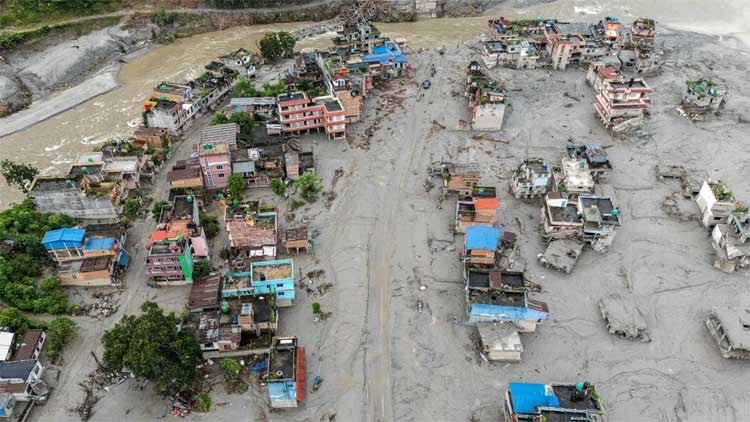
The catastrophic floods that tore through Nepal’s Himalayan valleys on August 26 have left behind more than a trail of death and destruction. They have also delivered a stark warning about the changing nature of disasters in a rapidly warming world.
The disaster began high in the Himalayas, where a massive collapse involving ice and rock sent torrents of water, mud and debris into the Lhende Khola river system near the Nepal-China border. The resulting surge raced downstream through the Bhote Koshi and Trishuli river corridors, devastating communities and critical infrastructure.
By September 4, Nepalese authorities estimated losses from the disaster at around 387.5 billion Nepalese rupees ($2.56 billion). More than 1,250 people had died and over 4,200 remained missing, according to officials, while thousands of homes and major infrastructure were destroyed or damaged.
The scale of the catastrophe has raised an uncomfortable question: Are countries prepared for disasters that develop faster than conventional warning systems can respond?
When a glacier becomes a disaster trigger
Unlike a conventional monsoon flood, the Nepal disaster involved a complex chain of hazards.
Scientists and satellite analysis indicate that an ice-and-rock mass collapsed at high altitude, triggering a landslide and temporarily blocking the Lhende River. The subsequent release of water and debris produced an exceptionally powerful flood downstream.
At one point, the Trishuli River reportedly rose by about nine metres in just 30 minutes, demonstrating how little time communities downstream may have had to react.
The event has also been described as a cascading disaster — one hazard triggering another and then another. Such events are particularly difficult to forecast because the danger does not originate from a single source such as heavy rainfall.
A warning from a warming Himalaya
The Himalayas are increasingly being viewed as one of the world’s major climate-risk zones.
Global warming is accelerating glacier melt and contributing to the destabilisation of frozen mountain terrain. Scientists warn that thawing permafrost, shrinking glaciers, unstable slopes and expanding glacial lakes could increase the potential for landslides, glacial lake outburst floods and other cascading disasters.
The Nepal flood does not mean that climate change alone caused every element of the event. The precise physical chain is still being studied. But experts say warming conditions can increase the instability of high-altitude environments and make extreme hazards more likely or more severe.
That distinction is important. The emerging threat is not simply more floods, but a greater possibility of unpredictable combinations of hazards.
The early-warning problem
Perhaps the most important lesson from Nepal is the speed at which the disaster unfolded.
Traditional flood-warning systems are often designed around monitoring rainfall, river levels and predictable changes in water flow. But when a glacier or mountainside suddenly collapses, the warning window can shrink dramatically.
Researchers have argued that stronger early-warning systems could have saved lives in Nepal. The Himalayan region contains thousands of glacial lakes, while numerous communities, roads, hydropower projects and settlements occupy valleys below unstable mountain terrain.
The challenge, therefore, is to move from single-hazard monitoring to multi-hazard warning systems capable of detecting landslides, ice avalanches, river blockages, sudden lake formation and downstream flooding as parts of the same chain.
Infrastructure under a new kind of threat
The disaster also exposed the vulnerability of infrastructure built in narrow Himalayan valleys.
Homes, bridges, roads and hydropower facilities were hit by a combination of fast-moving water, rock, ice and sediment. Several hydropower projects were severely affected, with hundreds of workers feared trapped or missing in tunnel systems. Rescue teams have since been using tunnel maps, satellite information, heavy machinery and other technology to search for survivors.
The economic consequences are enormous. Nepal’s preliminary damage estimate of $2.56 billion includes destruction to property, housing and infrastructure, while the immediate four-month recovery requirement has been estimated at around $52.6 million for roads, temporary shelters, drinking water and electricity restoration.
For a developing country heavily dependent on mountain infrastructure and tourism, repeated disasters of this magnitude could have consequences far beyond the immediate loss of life.
Nepal is not alone
The warning extends beyond Nepal’s borders.
The same Himalayan environment stretches across several countries, meaning a disaster originating in one part of the mountains can affect communities and infrastructure far downstream and across national boundaries.
The recent disaster has already prompted concern in neighbouring India’s Himalayan states. In Sikkim, authorities have identified 40 high-risk glacial lakes, including 16 considered to be at the highest level of risk, highlighting the potential for similar hazards in other parts of the Himalayas.
This makes regional cooperation increasingly important. Satellite monitoring, hydrological data, weather information and emergency alerts need to cross borders as quickly as the hazards themselves.
A new era of disaster preparedness
Nepal’s catastrophe may ultimately prove to be a defining warning for the Himalayan region.
The disasters of the past were often easier to classify: a flood, an earthquake, a landslide or an avalanche. The emerging reality is more complicated. A warming climate can destabilise glaciers and slopes, while extreme rainfall and changing weather patterns can interact with those weaknesses.
The result can be a cascade of hazards arriving with extraordinary speed.
Preparing for this new age will require more than emergency relief after a disaster. It will mean investing in high-altitude monitoring, satellite surveillance, community-level warning systems, resilient infrastructure and cross-border disaster coordination.
The human cost of Nepal’s flood is already staggering. But its most enduring legacy may be the warning it offers to the rest of the Himalayas: the next disaster may not look like the last one, and there may be far less time to prepare for it.
Comments are closed.